Feeds:
Posts
Comments

Well hello there!  I hope you all have been well.  I’ve been just a bit preoccupied with the start of summer, so my regular posting here hasn’t been so…regular.  It’s not due to a lack of cooking, however.  The fresh summer produce has been invigorating!  With my little boy out of school for the season, we’ve been having a blast.  You forget how magical summer break is for little kids.  Rivers, lakes, playgrounds, we’ve hit ’em all.  But, it’s time to get into a routine again, so I’ll be back later this week with a new delicious post for you!

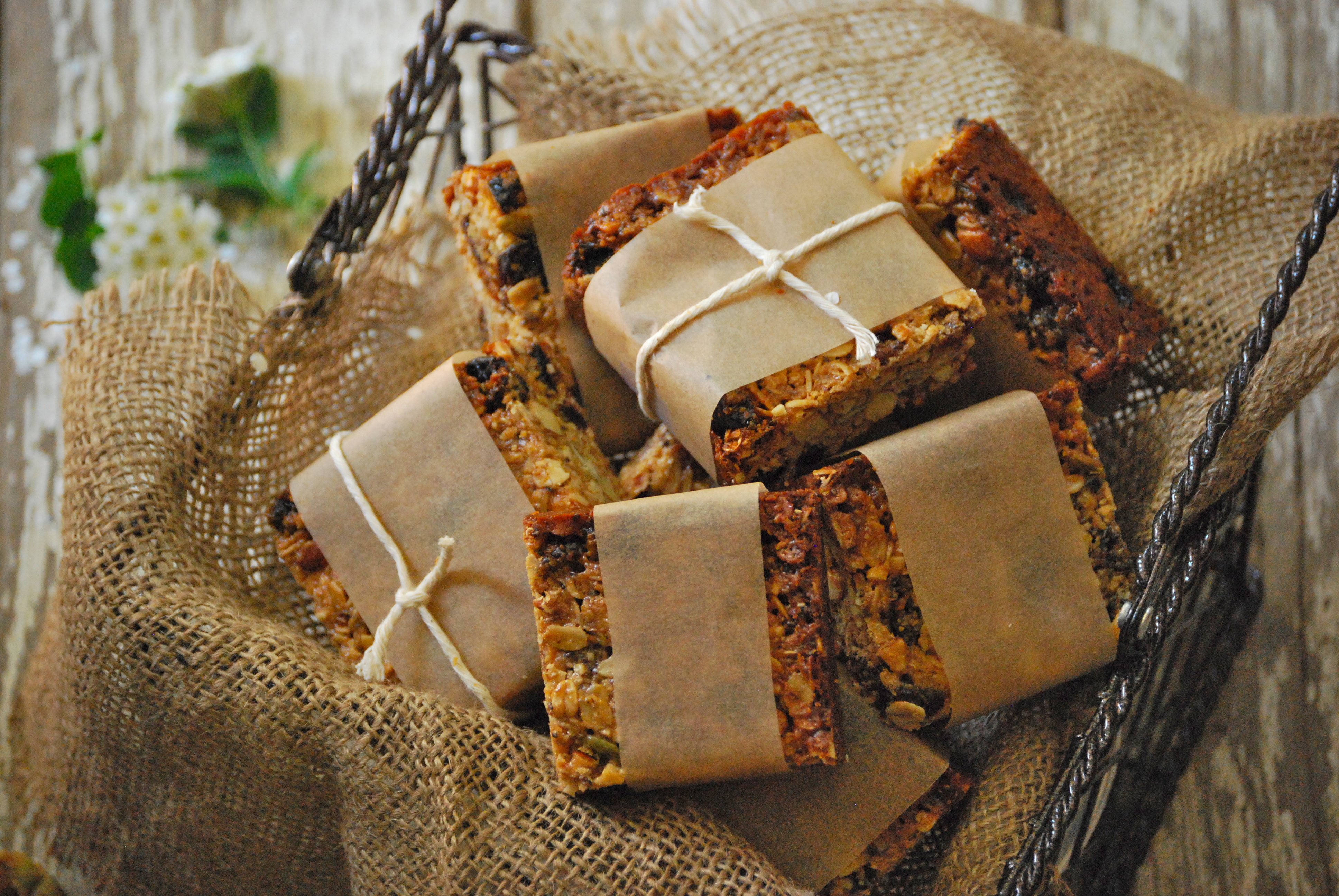
My friend Liz asked me to write a post for today on her wonderful blog, Carpé Season.  Liz just had a beautiful baby boy and is taking a little extra time to love him up this summer.  I’m sharing one of my favorite homemade treats on her blog– chewy granola bars.  These are, hands-down, the best granola bars I’ve ever eaten.  Ever.  So head over here and give them a look!

In the meantime, enjoy a few of these photos of my summer, so far.  See you soon!

Laurie

I guess I’m a liar.  I promised you greens and healthy fare this week, and instead I’m delivering cream and sugar.  I am the worst.  But it is nearly Summer after all, so why not get a little excited for homemade ice cream?  While strolling through a neighborhood garage sale a few weeks back I stumbled across a Krups ice cream maker.  For me, this was like striking gold.  Cool, creamy, delicoius gold.  You see, I’ve been wanting an ice cream maker for some time.  I had a chance to use a friend’s a few times and fell in love with the whole process.  So I gave the ice cream maker a home in my kitchen, and began to dream up flavor combinations.  The one criteria was that I wanted to make something that I couldn’t easily find in a grocery store.  I wanted something unique enough to be worth the effort.

Now to be honest, this peach cheesecake version wasn’t exactly what I had in mind.  In fact, it wasn’t even on the list.  This was just going to be a test-run using what I had on hand.  I always have cream cheese, and I knew there were gingersnaps in the pantry.  And there on my counter, were three lonely peaches.  You know the type– they were too hard to eat the first day, we forgot about them on day two, and by day three they were…past their prime, shall we say.  Like I said, this was going to be a test-run.

Well it turns out that my little cobbled-together recipe is dreamy.  The ice cream has a lovely, subtle, peach flavor.  If you want a more powerful fruit flavor, you’ll need to add another peach.  I wasn’t sure the cream cheese was going to work, since it wasn’t going to be perfectly smooth, but it ended up being my favorite addition.  There are wonderful little tidbits of cream cheese speckled throughout the peach and vanilla custard that give this a real cheesecake flavor.  The gingersnaps bring their little crunch for additional texture, and the flavor really marries well with the peach.  As with pretty much all of my recipes, I used the best organic ingredients I could find.  Hope you enjoy the ice cream– and eat a few vegetables before you indulge.

The Recipe:  Peach Cheesecake Ice Cream

(Makes a bit more than 1 quart)

2 cups heavy cream

1 cup 2% milk

5 egg yolks

1 vanilla bean

3 peaches, puréed to yield 2/3 cup

squeeze of lemon

1/2 cup granulated sugar

1/4 cup brown sugar, not overly packed

4 ounces cream cheese, at room temperature, and softened/mashed with a fork

1/2 cup chopped ginger snaps

kosher salt, to taste

To make the custard:  Add 1 cup of the cream, milk, brown sugar, granulated sugar, a healthy pinch of kosher salt, and the vanilla bean to a medium sized saucepan over medium-high heat.  Make sure to split the vanilla bean and scrape out the seeds with a sharp knife.  Add both the seeds and the pod to the saucepan.  Stir frequently to help dissolve the sugars.  Cook for about 3-4 minutes, or until tiny bubbles form around the pan.  Turn off the heat and let the mixture infuse for 1 hour.

In the meantime, peel and quarter the peaches.  Place them in a steamer basket in a medium saucepan over medium-high heat.  Let them steam until they are soft, about 2-3 minutes.  Place them in a small mini-processor with a squeeze of lemon.  Blend until smooth.  Let cool.

When the hour is nearly over, prepare an ice bath by placing a large bowl with ice and water in it, then place a medium -sized bowl into that one.  Pour the remaining cup of cream into the bowl so it becomes very cold.  This will help the custard cool more quickly.

Re-warm the cream mixture until tiny bubbles begin to form around the edge.  Remove from heat.  In a steady stream, pour half of the warm mixture into a bowl containing the egg yolks to temper them, whisking them the entire time.  Then pour that mixture back into the saucepan and cook over low heat.  Stir constantly and scrape the bottom with a wooden spoon or rubber spatula.  Cook until the mixture thickens slightly , coats the back of a utensil, and can hold a line drawn through it with a finger, about 4-8 minutes.  A thermometer will read 175°-180°F.  Do not let the mixture boil or it will curdle.

With a mesh strainer positioned over the bowl of cream in the ice bath, pour the hot mixture into it.  Stir the mixture until it cools to  70°F.  Add the peach purée and the softened cream cheese to the bowl. Use a whisk to mostly incorporate the cream cheese.  Some small bits that remain are perfect.  Then put the mixture into the refrigerator for 4 hours to cool.  Now it’s ready for your ice cream maker.  Follow the manufacturer’s instructions.  Mix the crushed gingersnaps into the churned ice cream.  Put into the freezer to fully set.  This ice cream is best if let to warm a few minutes before serving.  Enjoy!

Source:  Adapted from David Lebovitz’s The Perfect Scoop and Melissa Clark’s Cook This Now

Thanks for stopping by!

Laurie

For the record, healthy eating is NOT the theme on Relishing It this week.  Don’t worry, I’ll return with several wonderful recipes next week loaded with seasonal produce.  But not this week.  For now, let’s just enjoy these fantastic sticky buns  from earlier, and today’s ridiculously good mini-burgers.  I am a bit of a burger connoisseur.  I know, I know.  I say that about a lot of things.  But the fact is, if there’s a dish I like, I try as many versions of it as I can.  It’s almost as if I need to approach it from every angle.  For burgers, I have my favorite combinations.  I enjoy the fancy ones with melted brie cheese just as much as I enjoy the not-so-classic with swiss and sauerkraut (which is incredible, by the way).  And the classic thick piece of raw onion on a plain burger with ketchup and mustard is heavenly.  I could go on and on.

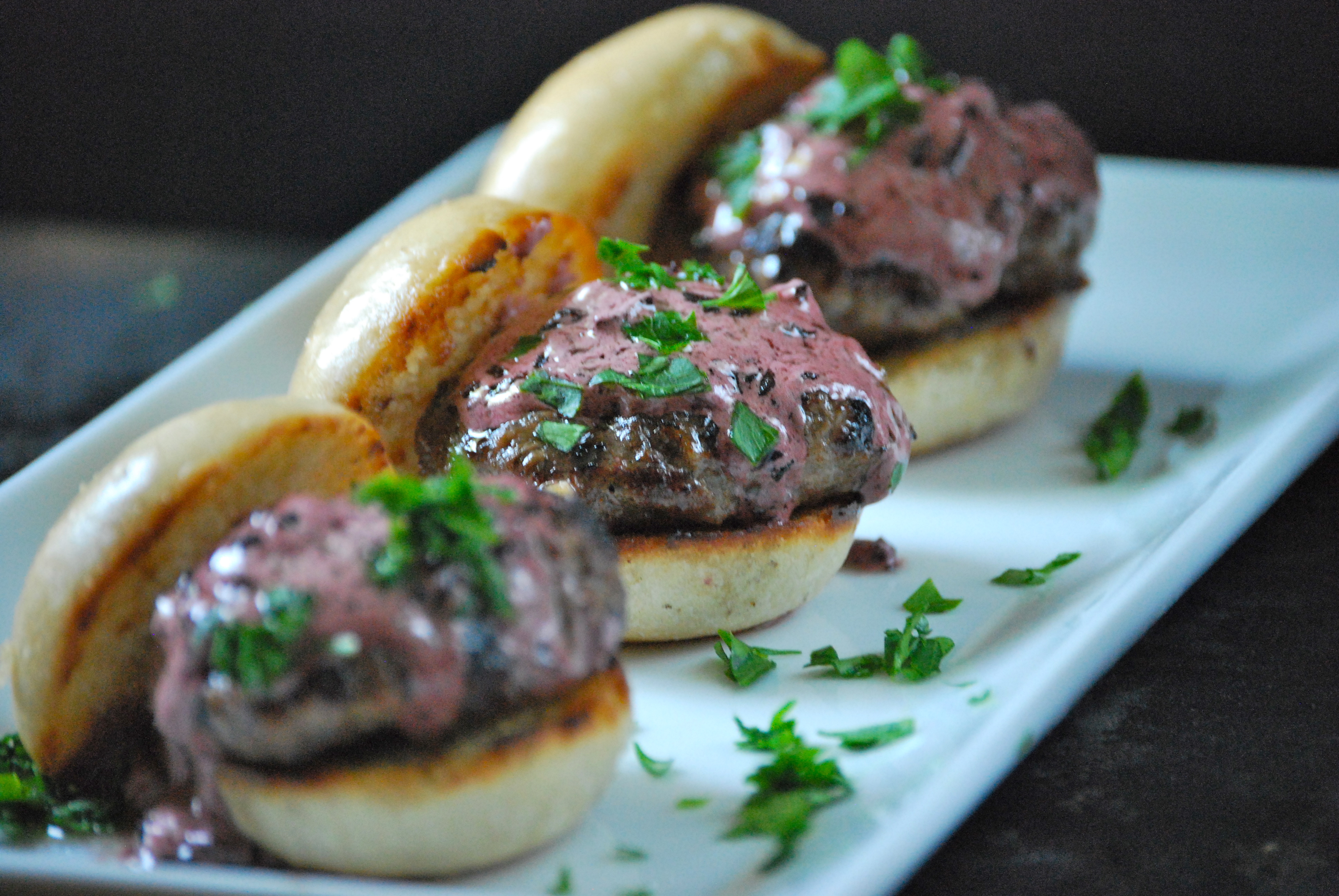
These mini-burgers (I have a hard time calling them ‘sliders’, because it just reminds me of White Castle) with red wine shallot butter are one of my favorite glammed-up ways to eat a burger.  They are, quite simply, amazing.  More like, over-the-top amazing.  I could eat them everyday, but my clothes would not fit within a few weeks.  They’re perfect if you’re looking for a show-stopper for a Summer party.  You can make everything ahead of time, and once the guests arrive, just pop them on the grill.

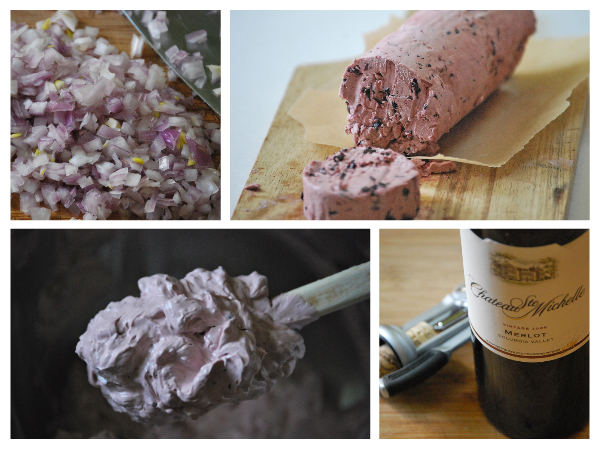
One of the biggest flavors– and certainly the biggest time consumer– is making the incredible red wine shallot butter.  You reduce an entire bottle of red wine with one cup of shallots, for about an hour.  Once it’s reduced, you mix this into the whipped butter and chill it.  This butter is the key to the whole dish, and it’s so intense that you only need a little pat on your burger.  You’ll see in the photos that I tend to add a thicker slice, because I just can’t get enough of the flavor.  When you make the red wine shallot butter, you’ll end up having some left-over.  This is good, because it keeps well in the freezer and can be used later…perhaps on a steak for the weekend?

I flavored the grass-fed beef with onions and a fair amount of fresh thyme.  The thyme adds a wonderful earthiness and pairs perfectly with the red wine and shallots.  And yes, if you’ve looked ahead to the recipe, you’ll see there’s also butter mixed in with the ground beef.  It works here, because the grass-fed beef is so lean.  Trust me on this, it’s phenomenal.  Personally, I like these burgers in mini-form.  I made the sourdough buns in the photos, as well.  They ended up being a perfect fit.  Find whatever small bun you can, or make your own.  Just gather some friends and make these burgers, everyone will be happy.

The Recipe:  Grass-Fed Mini Burgers with Red Wine Shallot Butter

For the Burgers:

2 pounds grass-fed ground beef

1 stick unsalted butter

1 medium white onion, minced

1 3/4 tablespoons chopped fresh thyme

1 1/2 teaspoons freshly cracked pepper

1 egg, lightly beaten

1 1/2 tablespoons kosher salt

Freshly chopped parsley

Red Wine Shallot Butter

1/2 cup minced shallots

2 tablespoons granulated sugar

1 bottle of red wine (Merlot or Cabernet work great)

1/2 pound unsalted butter, whipped

To make the red wine shallot butter:  In a large saucepan, combine the shallots, red wine, and sugar.  Bring to a boil, then reduce heat to a medium simmer.  Continue to reduce for about an hour  until the mixture it is somewhat “syrupy”, but almost dry.  See photos.  Remove from heat and let cool to room temperature.  Mix into the whipped butter until homogenous.  Use parchment paper or plastic wrap to roll into logs and chill until firm.

To make the burgers:  Remove ground beef from the refrigerator for about 1/2 hour before mixing.  It’ll need to warm a bit to properly mix with the butter.  In a medium skillet over medium-high heat, add about 2 tablespoons of the butter and the onion.   Sweat them until they are translucent.  Remove from heat and cool to room temperature.  In a large bowl, add the thyme, pepper, egg,  salt, and onions.  Whip the remaining butter until smooth.  Add the butter and ground beef to the bowl and mix until just combined, being careful not to over mix (which can lead to a tough burger).  Form into patties and place on waxed paper and chill in the refrigerator for at least an hour.  Grill or fry the burgers and top with a slice of the red wine shallot butter and a sprinkle of parsley!

Source:  Adapted from Bar Lurcat, in Minneapolis, MN

Thanks for stopping by Relishing It!  Hope you all have a safe and fun holiday weekend!

Laurie

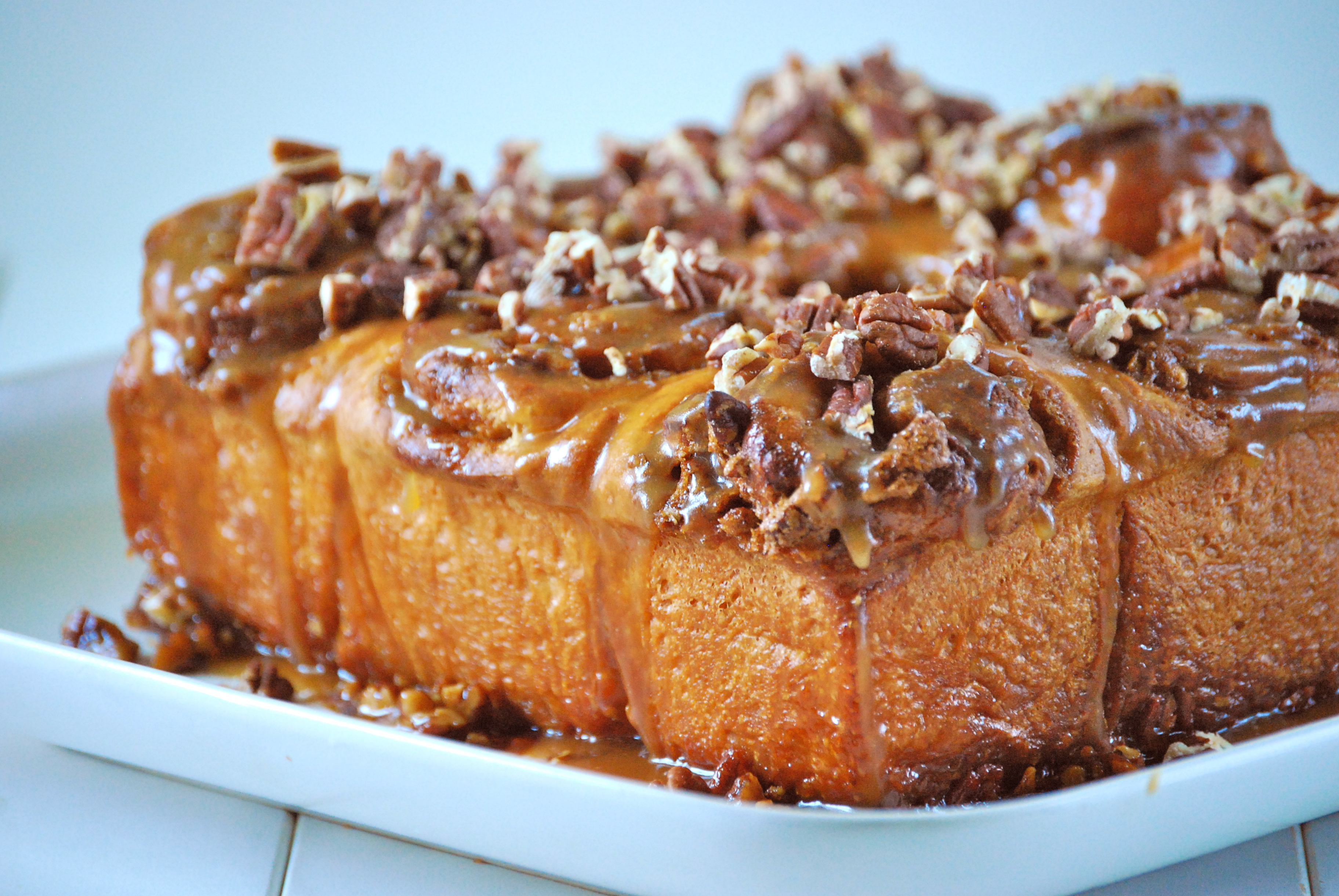
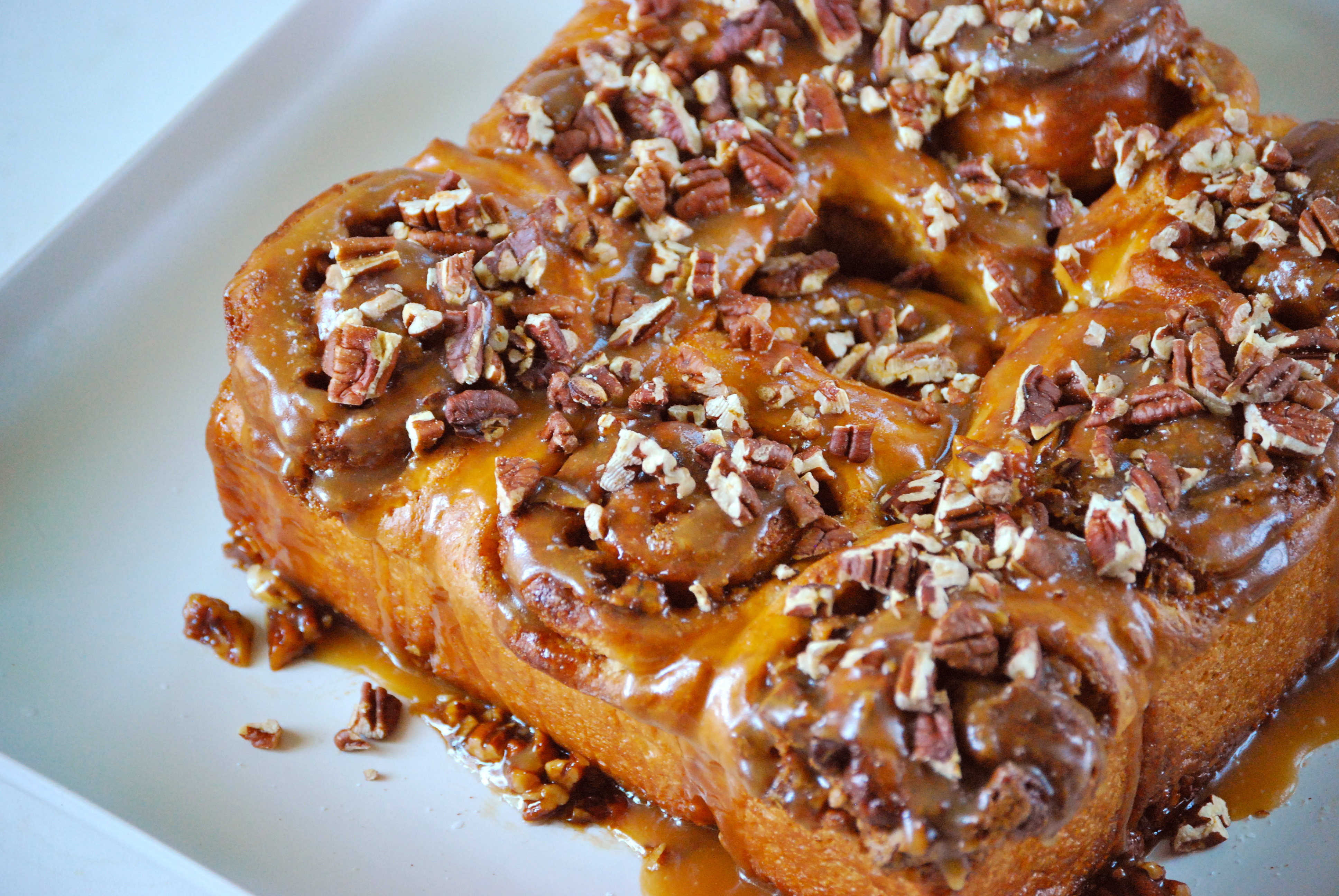
One of the best smells in the world– especially on a weekend morning– has to be homemade caramel sticky buns baking in the oven.  The sweet scent of cinnamon wafting through the house, along with the earthy aroma of toasted pecans, is just… divine really.  Caramel sticky buns are one of my family’s favorite weekend treats, so a few years ago we began to scour the Twin Cities for the best ones.  We found a few gems, but more often than not, we were disappointed.  Many were too ‘bread-y’, others were covered in so much caramel that they were just a mess, and a few were hard, crunchy disasters.

Aside from returning to that handful of favorites that we did find, I decided to work on a version that was just right.  I try new sticky bun recipes all the time– I really do.  We’ve gone through a few that are really tasty, but this one is the best.  And it’s better than any we’ve found in local bakeries or cafe’s.  Honestly, it’s perfect.  It makes a nice tall bun that is soft and tender– not too dense– with a lightly-crunchy top.  The dough is soft, buttery, and very easy to work with.  It rolls out beautifully.

One interesting thing about this recipe is that the caramel is on the top and bottom of the roll.  This means you don’t invert the rolls when they’re finished.  Instead, you top them with another helping of caramel.  The result is an even distribution of the caramel throughout the roll.  It’s a simple difference, but it’s genius.
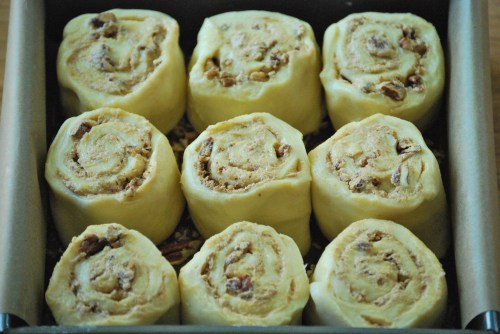
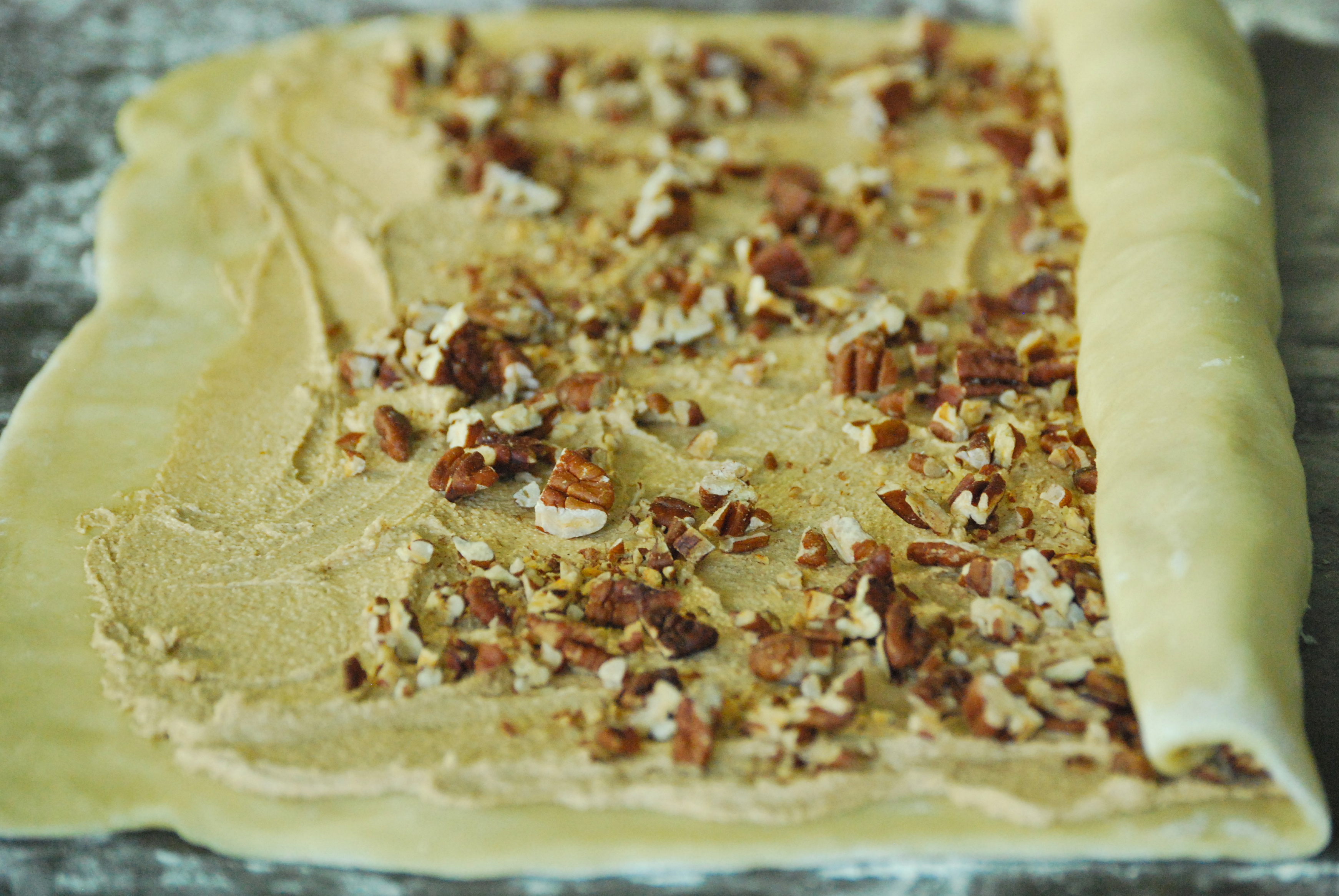
Another thing that makes these buns different from most recipes is that for the filling, you whip the butter along with the brown sugar, cinnamon, and nutmeg (nutmeg makes everything better).  In most other versions, you just spread the butter and sprinkle on the spices.  It makes an amazing difference, so do not avoid this step.  You’re going to want to lick the mixture right off the spoon!

These buns are wonderful to prepare ahead of time.  You can do this a few ways.  First, the dough can be refrigerated (it needs to chill for at least to two hours before it can be rolled into buns, anyway).  Another option is to finish the buns, get them into the pan, and refrigerate overnight.  The rise time will be a bit longer (because the dough is cold), but it makes having a fresh sticky bun in the morning so much easier.  Finally, you can just make them the night before– including the baking– since these one’s stay soft and moist.  In the morning, just top them with the last of the caramel and toasted pecans.  Hope you enjoy these sticky buns as much as we do!

The Recipe:  Perfect Caramel Sticky Buns

(Makes 9)

For the Dough:

2/3 cup whole milk

5 tablespoons sugar, divided

1 3/4 teaspoon active dry yeast (from one 1/4-ounce envelope)

2 large eggs, at room temperature

2 3/4 cup (14 ounces) unbleached all-purpose flour

1 teaspoon kosher salt

1/2 cup (1 stick) unsalted butter at room temperature, cut into 1-inch pieces, plus a bit more melted

For the Caramel Topping:

2 cups chopped pecans, toasted

1/2 cup (1 stick) unsalted butter

3/4 cup (packed) dark brown sugar

3/4 cup heavy cream

1/3 cup honey

1/2 teaspoon kosher salt

For the Filling:

1/2 cup (1 stick) unsalted butter, at room temperature

1/2 cup (packed) dark brown sugar

1 teaspoon ground cinnamon

1/2 teaspoon freshly grated nutmeg

pinch of kosher salt

flour, for dusting

1 egg, for brushing on the buns

Sea salt

Prepare the dough by heating the milk in a saucepan or microwave until the temperature registers 110-115°F.  Mix in the yeast and 1 tablespoon of the granulated sugar.  Let it sit for 5 minutes to get foamy.  Add the eggs and whisk until smooth.  Add the remaining sugar, flour, and salt into the bowl of a stand mixer fitted with a hook attachment.  Give the mixture a quick stir with a whisk, then add the wet ingredients.  Turn the machine on and mix until it’s a shaggy mess.  Add the butter, one chunk at a time, making sure to wait until each piece is mostly incorporated.  When everything is incorporated, knead the dough on medium  for about 5 minutes.  The dough should be soft and silky.  Place the dough into a large bowl that has been lightly coated with melted butter.  Pour a bit more of the melted butter on top of the dough and spread evenly with your hands.  Cover with plastic wrap and refrigerate for at least 2 hours or up to 1 day.

Toast the pecans by placing them on a baking sheet in a 350°F oven for 10-12 minutes, or until fragrant.  Let cool.

Prepare the caramel by melting the butter in a small saucepan.  Add the brown sugar, cream, honey, and salt.  Bring to a boil and reduce heat to medium.  Let continue to cook for about 3-4 minutes.  The glaze will be a deep golden brown.  Pour one cup of the glaze into an 8×8-inch pan.  Sprinkle 1/2 cup of the toasted pecans over the glaze.  Reserve the remaining glaze (refrigerate with a cover, if using much later).  Note: I’ve made these rolls by lining the pan with parchment paper so they could be easily removed and placed on a platter.  It also works just as easily to put them into the pan with nothing at all — the choice is yours.

Prepare the filling by placing the butter, cinnamon, salt, brown sugar, and nutmeg in the bowl of a stand mixer fitted with a paddle attachment. Mix for 2-3 minutes, or until light and fluffy.  Set aside.

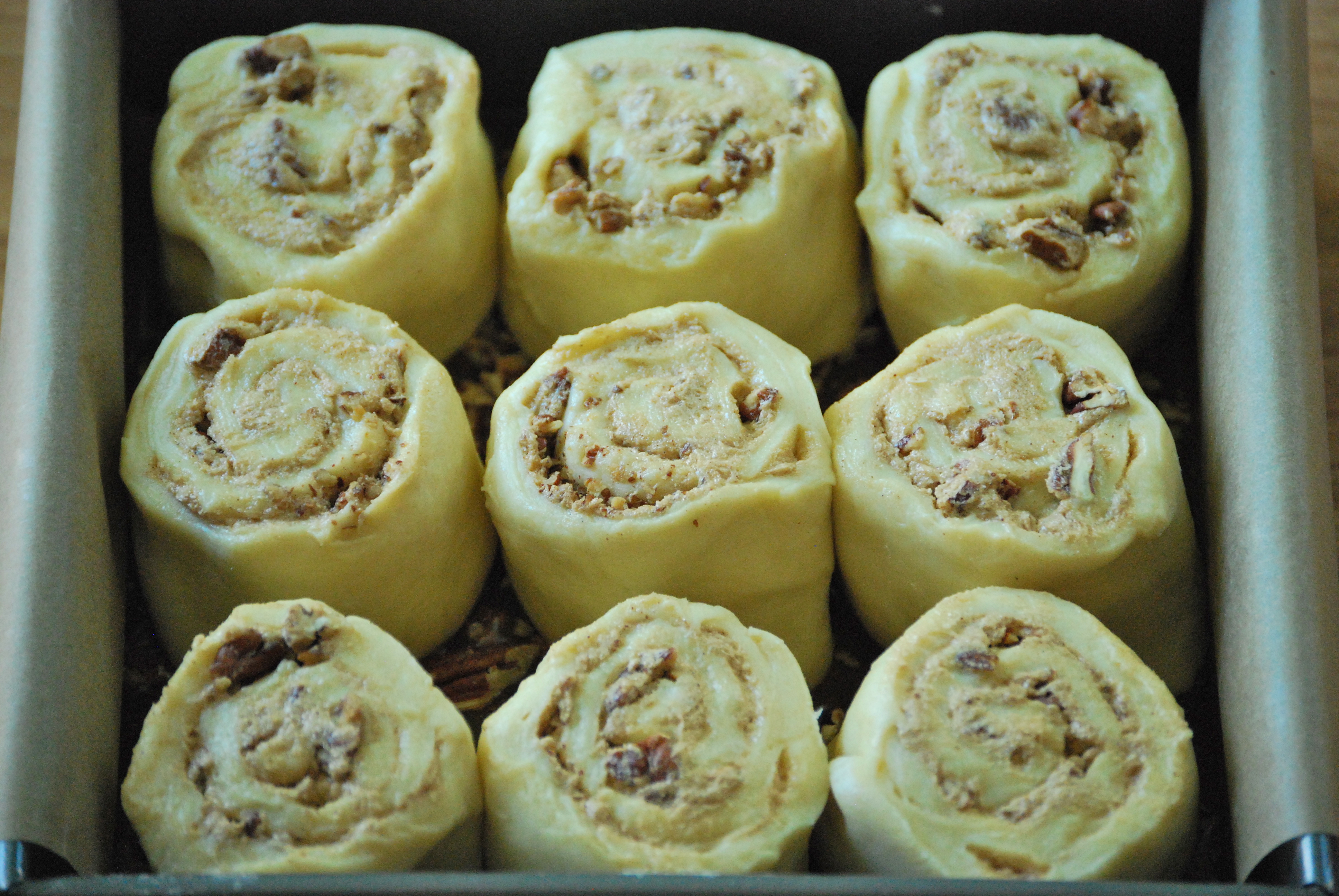
Form the buns by putting a light coat of flour down on a work surface.  Roll the chilled dough into a 12 x 16-inch rectangle.  Spread the butter/spice mixture on it, leaving a 1-inch plain border on the side furthest away from you.  Sprinkle 3/4 cup of the pecans over the butter (reserve the remaining pecans — put into an airtight container, if using much later).  Roll the dough into a tight log.  Cut and discard the very edges, if they are uneven.  Cut the remaining dough into 9 equal pieces.  Re-shape if they flatten out in the cutting process.  Place them in the pan and cover with plastic wrap or a light kitchen towel.  Let rise in a warm, draft-free area for about 45 minutes, or until the dough has doubled in size ( 1 1/2 – 2 hours, if the dough has been chilled overnight).

After the buns have properly raised, whisk the egg with 1/2 teaspoon of water and brush onto the buns.  Place the pan of buns on a baking sheet and put into a 350°F oven and bake for about 50 minutes, or until a thermometer registers 185°F in the center.    Remove from oven and let cool for a bit.  Pour remaining glaze on the buns and top with the pecans.  Sprinkle with sea salt and enjoy with a hot cup of coffee.

Source:  Adapted from Bon Appetite

Thanks for stopping by RelishingIt today!

Laurie
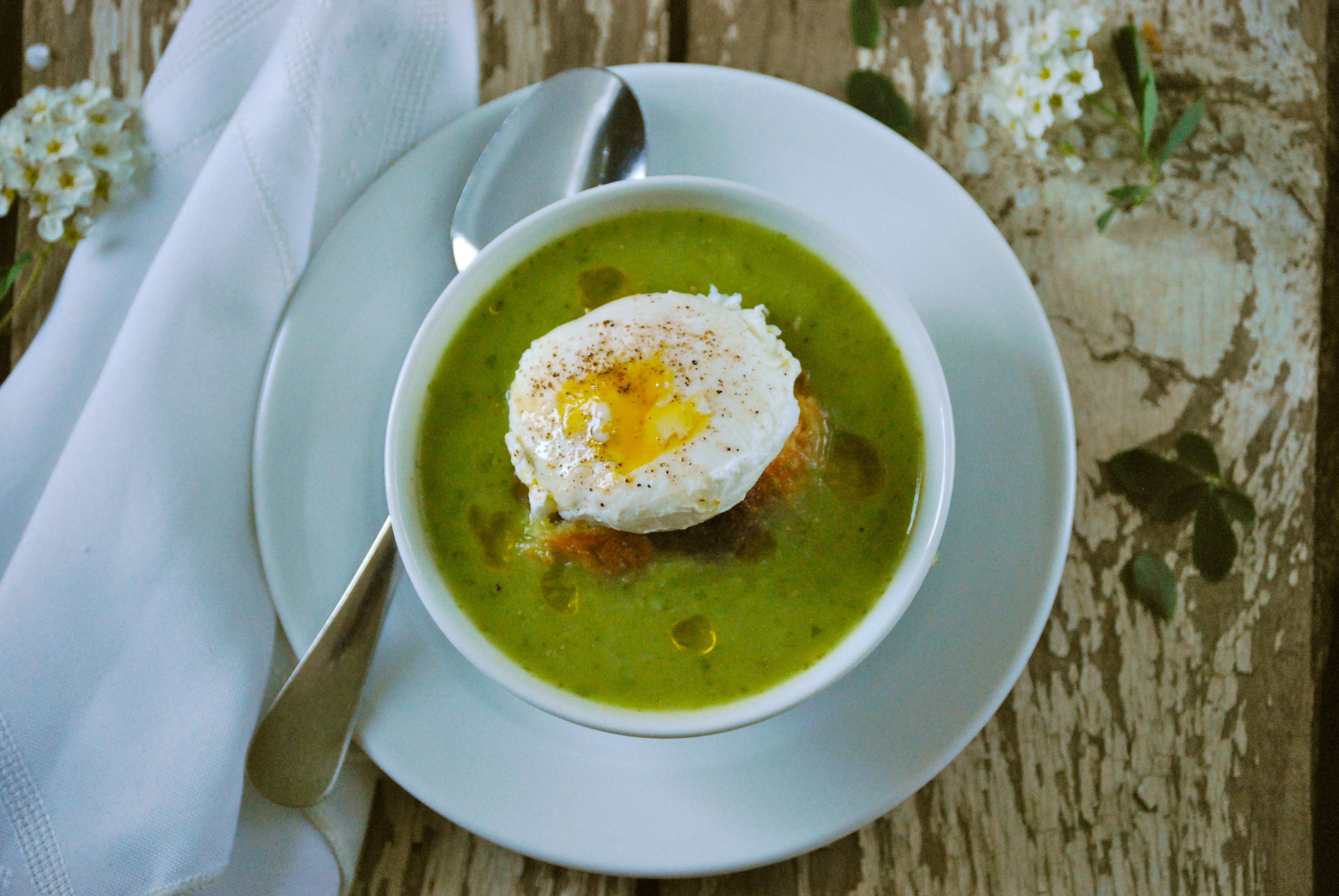
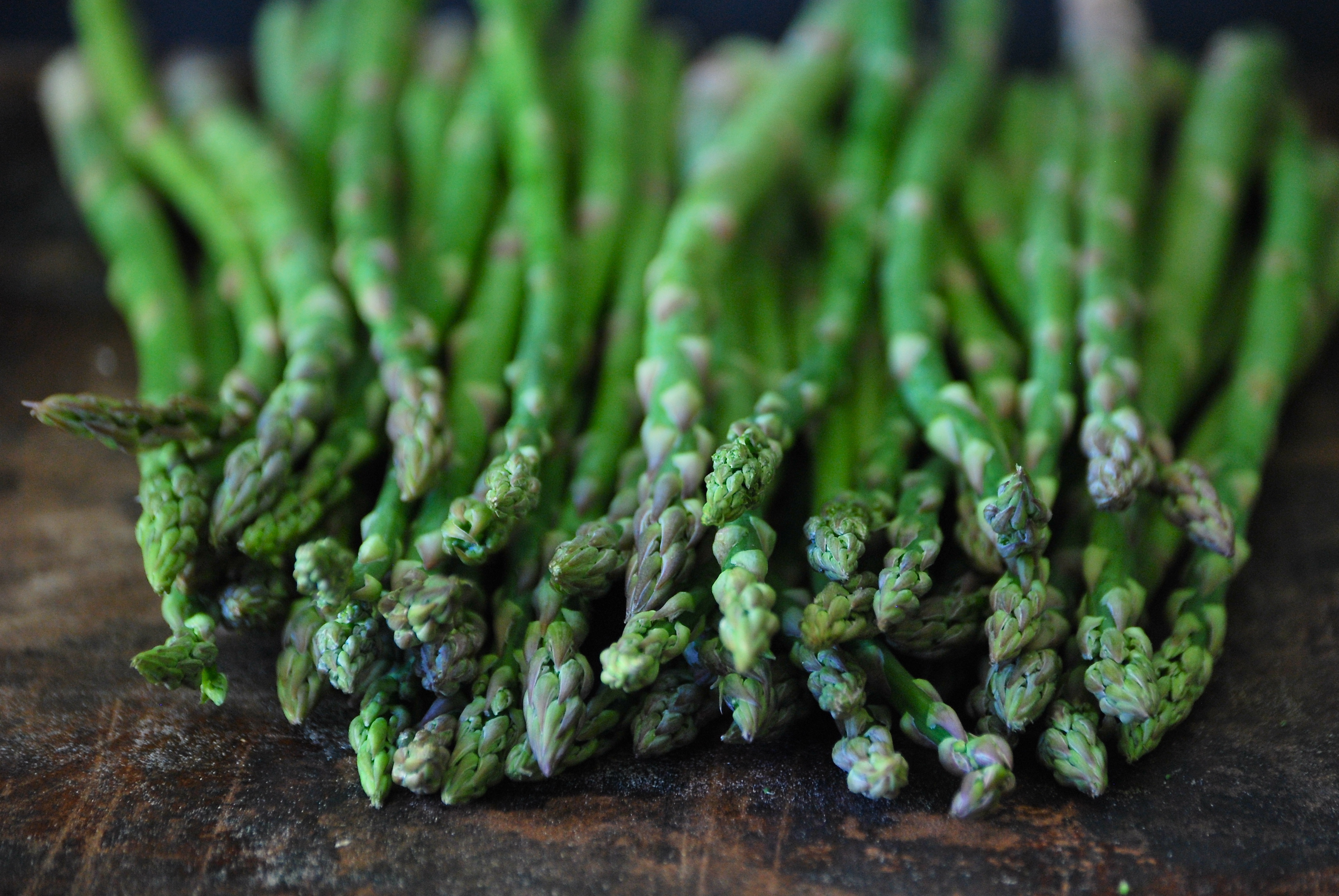
Today’s recipe is another healthy, vegetable-laden dish– a fresh, simple soup that is brilliant served hot or cold.  See, I told you I was going to eat my weight in veggies.  This week the seasonal produce in my refrigerator– asparagus, pea shoots, and leeks– was just begging to be made into something wonderful.  This soup is the result.  It’s simple, though with seriously impressive flavors.  What I mean is, even though it comes together in about 30 minutes from start to finish (if you’re skilled with a chef’s knife), it tastes surprisingly complex.

From the first spoonful, you can distinctly taste each of the main vegetables.  Clean and crisp.  And the lemon adds that nice acidity that frames the flavors of the asparagus, pea shoots, and leeks.  As you stroll through the recipe, you’ll notice there are no herbs or spices (aside from salt and pepper).  For this soup, I wanted the pure flavor of the vegetables to stand out.  I also knew I didn’t want it packed with cream (though I love, love creamy soups).  Instead, I added a Yukon Gold potato to provide that smooth texture.

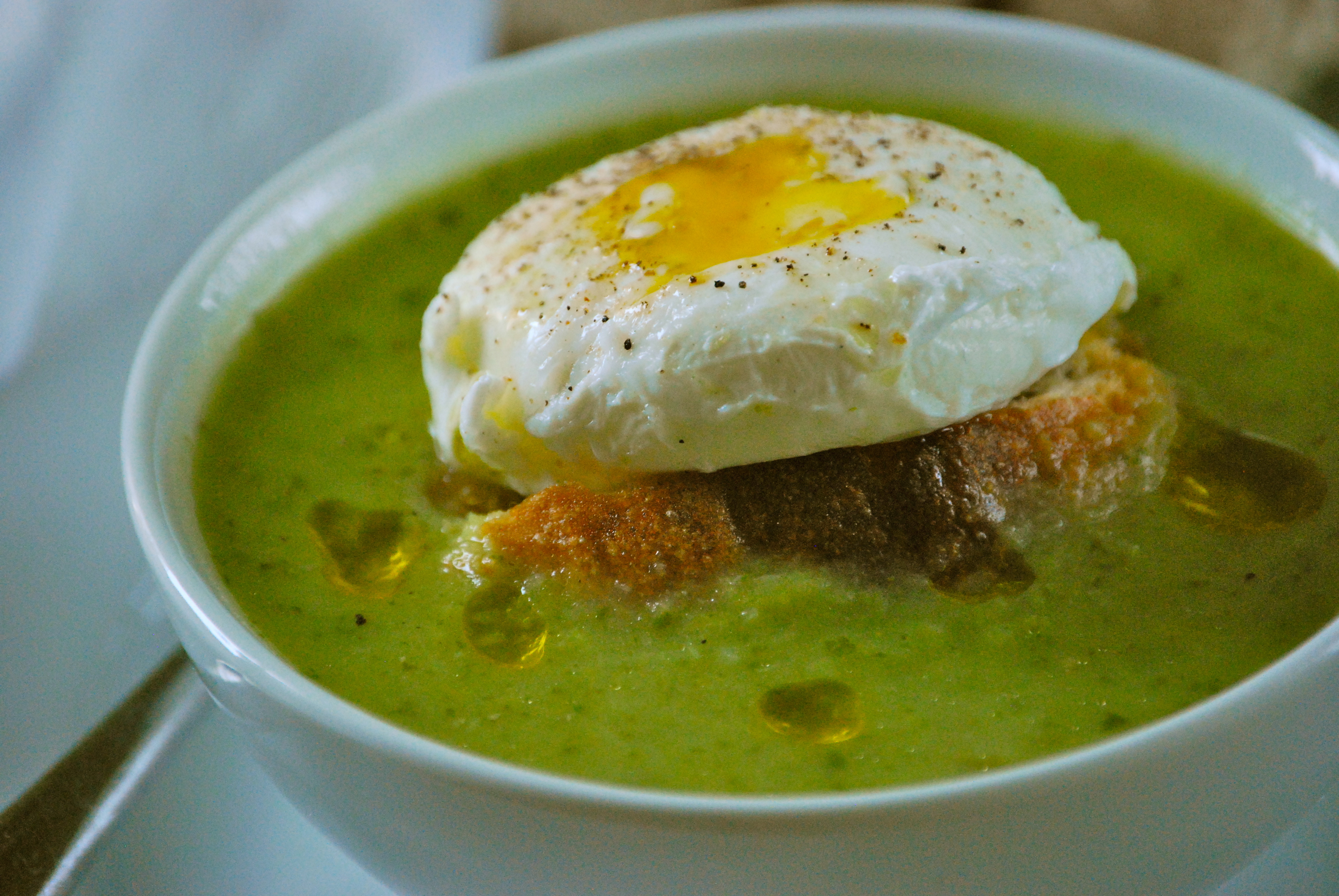
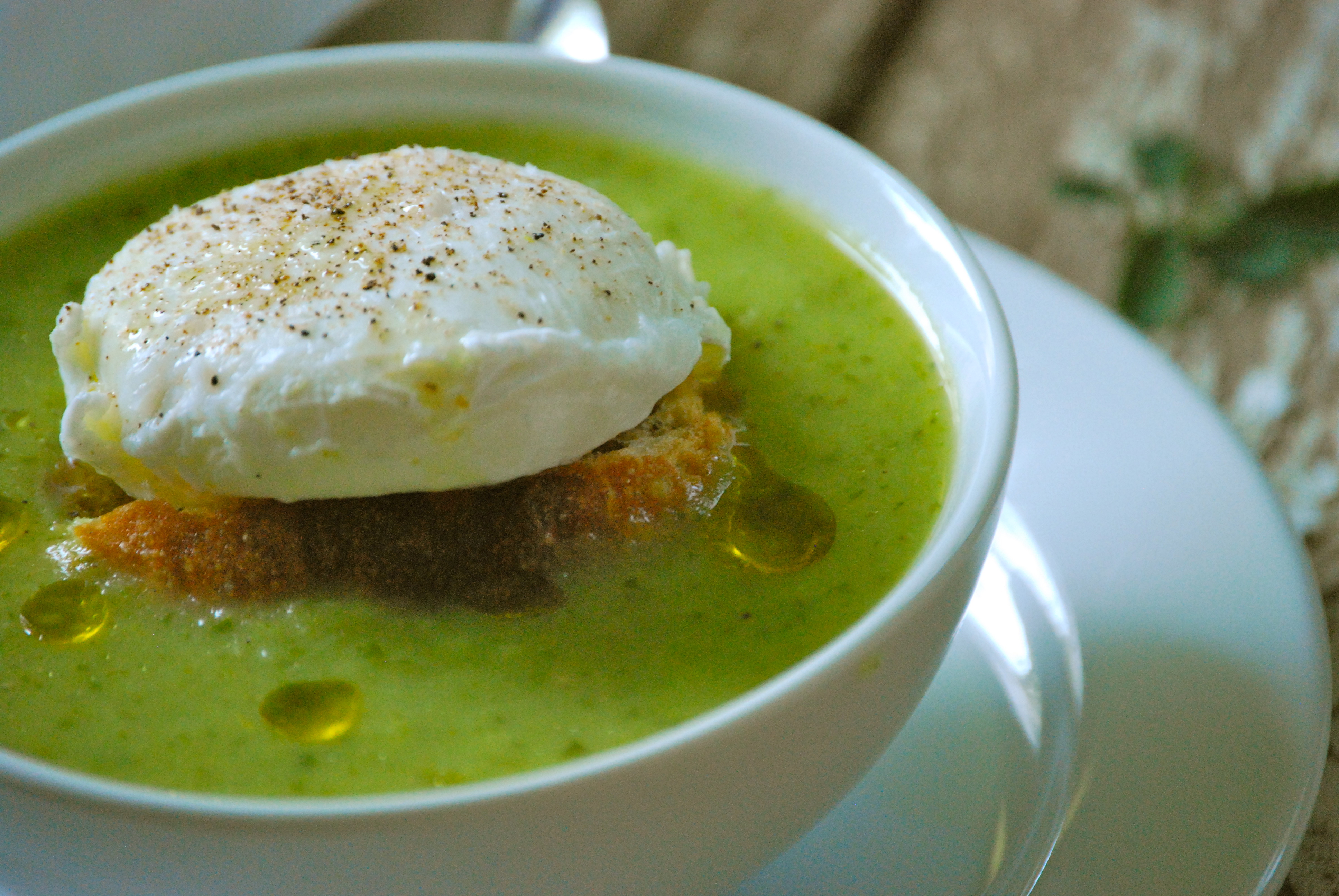
This soup is very good by itself– especially as a chilled Summer dish.  I also love it warm with a piece of toasted french bread and poached egg gently laid on top.  Magic happens where egg yolk meets soup.  Give it a try, you’ll see.  One last thing to keep in mind is that the balance of flavors in this soup stands or falls on how much lemon and salt you add.  As always, taste, taste, taste!

The Recipe: Spring Vegetable Soup

(Serves 4 — enjoy hot or cold)

1 quart chicken stock

2 tablespoons extra virgin olive oil, plus more to drizzle

1 pound asparagus

1 large white onion, chopped

1 medium leek, chopped

2 stalks celery, chopped

1 large yukon gold potato, peeled and chopped

1 packed cup of pea shoots

squeeze of lemon

sea salt and freshly cracked black pepper

crusty french bread and poached eggs, optional

Prepare the asparagus by trimming the very ends.  If you have some thick ones, peel the last 1 1/2-inch of the stock with a vegetable peeler.  Cut off the tips of the asparagus and set aside.  Cut up the remaining asparagus into 1-inch pieces.

In a large Dutch oven or heavy-bottomed soup kettle, add the olive oil.  Over medium heat, sauté the onion, leek, celery and a sprinkle of salt and pepper until tender, about 5-7 minutes.  Add the chicken stock, potato, and asparagus.  Bring to a boil, then reduce heat.  Simmer for about 15-20 minutes, or until the potatoes and asparagus are tender.  Then, put the pea shoots into the soup and cook for about 1 minute, or until the pea shoots have wilted a bit.

Meanwhile, bring a small saucepan of water to a boil.  Add the reserved asparagus tips and cook for about 2 minutes.  Remove from water and place into an ice bath to stop the cooking process.  Set aside.

Remove soup from heat.  Use an immersion blender or carefully pour the soup into a stand blender (in batches), blend the soup until creamy.  Season with a squeeze of lemon, to taste, as well as salt and pepper.  Seasoning this soup properly is key.  A bit more lemon or salt can make all the difference.   Add the asparagus tips to the soup or serve as a garnish on top.  This soup is wonderful served hot or cold.   It is outstanding served with toasted french bread and a poached egg on top.  Drizzle with olive oil.  Enjoy!

Thanks for stopping by Relishing It!  Have a fantastic weekend!

Laurie
I just returned from my nine-hour-each-way road trip to North Dakota.  I do my best to eat healthy when I travel, but sometimes I end up failing miserably.  This trip I had a hard time saying no to the most delicious bacon cheeseburger in the universe– again.  And it went downhill from there.  Now I’m making up for my gluttony by trying to eat my weight in vegetables, and today’s post is a good start.

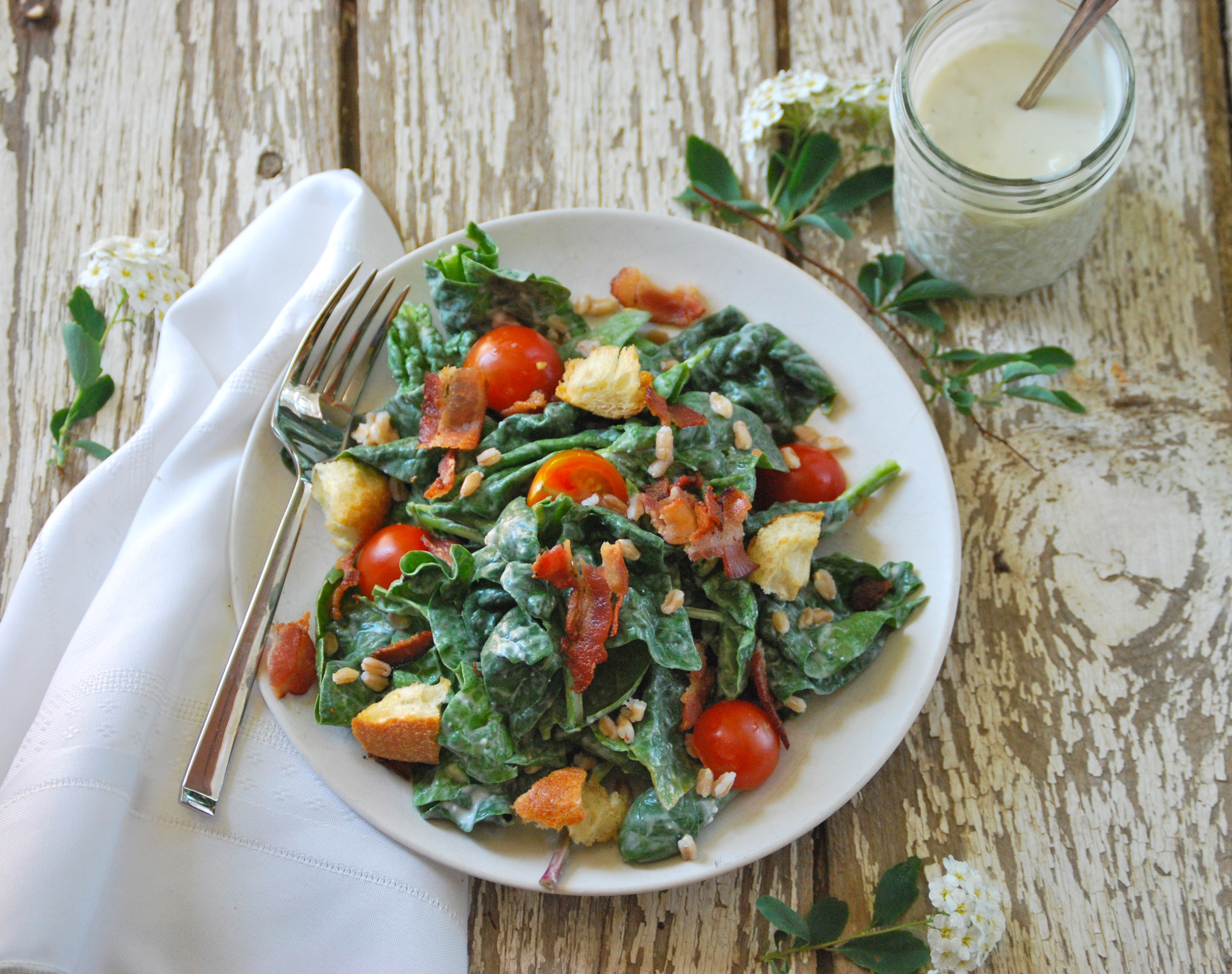
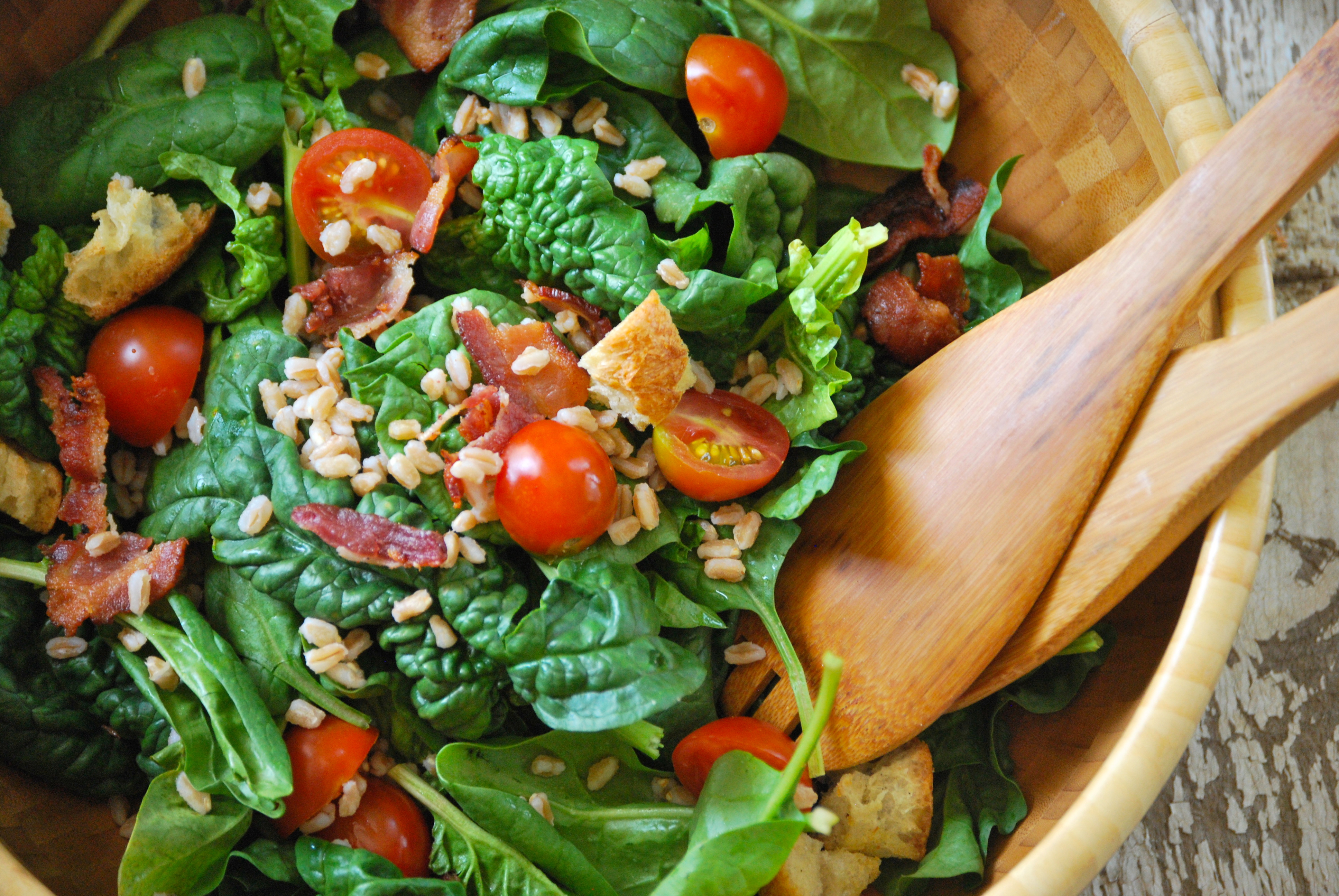
I’ve been craving a crisp spinach salad for awhile now.  Not the pre-packaged spinach that has “bag smell”, but fresh garden spinach that you can find at almost every farmers’ market.  I’m talking about the kind that is curly, has loads of wrinkles, and personality.  And although tomatoes aren’t quite in-season here in Minnesota, I knew I could get a few greenhouse-grown beauties.  Along with the veggies, I wanted a few crunchy bacon crumbles– not much, just a enough to add a nice saltiness.  Since I was thinking about a salad that could serve as a complete meal, I mixed in a whole grain.  You’ve probably noticed that I do this a lot with my salads.  This one and this one are two earlier favorites.  This time around, I chose farro.  It comes from the wheat family and has a nice, toothsome bite.  Finally, I wanted to bring it all these fresh ingredients together with a creamy gorgonzola dressing.

I know there are a many of you that purchase bottles of salad dressing from the grocery store.  My goal for today is to convince you to start making your own for every salad.  It’s easy, and tastes amazing.  No preservatives, and you know exactly what is going into your dressing.  Plus, you can play around with the ingredients.  Switch out the gorgonzola for blue cheese.  If you have extra yogurt on hand, use that instead of the buttermilk.  Just give it a try.  I’m guessing you’ll like it enough that you won’t buy bottles again.  This particular dressing is simple and beautiful.

One last note about Spring spinach.  You’ll need to clean it thoroughly– more than just a spray of water and throwing it in the salad spinner.  Instead, soak it in a large bowl of cold water for a minute or so to allow the dirt to settle to the bottom.  You don’t want to ruin this beautiful salad by biting into a fresh green leaf that still has dirt hidden in one of the folds.  Enjoy!

The Recipe:  Spinach, Farro, and Bacon Salad with Gorgonzola Dressing

1 large bunch fresh spinach

small bite-sized tomatoes

8 ounces bacon, cooked

handful of homemade croutons

1/2 cup farro, cooked

lemon

4 ounces (1/4 pound) gorgonzola cheese

1/2 cup buttermilk

sea salt and cracked black pepper

To start, rinse the farro in a mesh strainer.  Place the farro in a small saucepan and cover with water by about an inch.  Bring water to a boil, then reduce to a small/medium simmer.  When the farro is tender, but still has a toothsome bite to it,  remove from the heat — about 15-20 minutes.  Pour into a strainer and let cool.

Preheat oven to 350°F.  Prepare the homemade croutons by cubing about 1/4 of a fresh or day old baguette.  Place on a baking sheet and drizzle with a bit of olive oil (about 2 teaspoons) and a sprinkle of salt and pepper.  Toss to coat.  Place in the oven and toast for about 10-15 minutes, stirring a couple of times.  They are done when they are golden brown and have a nice crunch to them.

Prepare the dressing by placing the gorgonzola cheese in a medium-sized bowl.  Add the buttermilk.  Mash with a fork until it is mostly incorporated.  Be careful to leave some small chunks of cheese, as it adds to the texture of the dressing.  Add a squeeze of lemon and salt and pepper, to taste.  Set aside.

Fill a large bowl with cold water.  Place the spinach in the bowl and swish it around a bit, then leave it alone.  All the of the dirt will sink to the bottom.  Gently remove the spinach and place in a salad spinner.  Give it another rinse with running water and then spin it dry.

In a large salad bowl, place the spinach, tomatoes,  farro, and bacon.  Pour some of the dressing on it.  Toss and top with croutons.  Enjoy!

Thanks for stopping by Relishing It  — have a lovely day!

Laurie
Every once in awhile an idea for a recipe pops into my head, and I can’t believe I hadn’t considered it before.  On the one hand, I get a bit disappointed in myself for missing something so obvious.  But then I think, ‘Who cares?  This is going to be incredible!’  Today’s recipe came from one of those epiphanies.  I wanted something bursting with Spring flavors, and this pea shoot and mint pesto does just that.

Pea shoots should be showing up at your local farmers market right now.  If you haven’t tasted them before, please go buy some.   These tasty little shoots are the young tendrils and leaves of the pea plant.  They’re packed with nutrients, including vitamins A and C.  And they’re wonderful on sandwiches, salads, mixed into stir fry, pureed into soups– and of course, in this pesto.

Mint and peas make a great combination– remember this carbonara?  Pea shoots taste like fresh peas, but you don’t have to go through the fuss of shelling.  Here, I blanched the pea shoots for a few seconds to brighten their color.  I added a few mint leaves, and finished it off with a squeeze of fresh lemon.  Do not leave out the lemon!  It’s fine without, but we’re looking for better than ‘fine’ with this pesto.

A couple tips on the bruschetta:  First, make sure you grill the bread.  Season it with olive oil, salt, and pepper.  It makes a huge difference.  I also recommend tearing– rather than cleanly slicing– the mozzerella.  It creates nice crevices and curves to drizzle the olive oil into.  I think it also happens to  look much more interesting.  The radishes add an additional pop of color and fresh crunch.  Aside from using this pesto on bruschetta, you can add it to pasta.  If you think it’s going to be too thick to toss with pasta, add a little more olive oil and remember to always reserve a bit of hot pasta water to get the texture you want.  Either way, I think you’ll be happy with this fresh dish.  Enjoy!

The Recipe: Bruschetta with Pea Shoot Mint Pesto and Fresh Mozzarella

Pea Shoot Mint Pesto:

1 1/2 cups packed pea shoots

2-3 tablespoons freshly grated parmesan or grana padano cheese

1/4 cup lightly toasted walnuts, chopped

1 garlic cloves

10 fresh mint leaves

1/4 cup extra-virgin olive oil

squeeze of lemon juice, to taste

sea salt and freshly cracked pepper, to taste

hot pepper flakes, to taste

For the Bruschetta:

1-2 balls of fresh mozzarella

1 -2 cloves of garlic

extra-virgin olive oil

pea shoot  mint pesto

handful of radishes, diced

Good quality rustic bread, sliced  ( I used sour dough)

To make the pesto:  Bring a medium sized saucepan filled with water to a small boil.  Prepare an ice bath, set aside.  Place the pea shoots in the hot water for 30 seconds.  Remove immediately and submerge into the ice bath.  Remove pea shoots from water and gently “wring” them out.  It’s ok if they have a bit of water on them.  Let cool.

Place the pea shoots, mint leaves, and 1 clove of garlic in a mini-food processor.  Pulse a few times, until the greens are adequately chopped.  Add the parmesan or grana padano and walnuts, pulse a few more times.  With the processor running, slowly drizzle in the olive oil.  You may need to stop the machine and scrape down the sides of the bowl.  Once the pesto is thoroughly combined, taste it.  Stir in some salt, cracked pepper, hot pepper flakes, and a squeeze or two of lemon to brighten the pesto.  Use immediately or store in the refrigerator with plastic wrap placed directly on it.

To make the Bruschetta:  Fire up your grill.  Brush olive oil on both sides.  Sprinkle with salt and pepper. Place on a hot grill and let it toast on each side until it is beautifully golden, but not burnt.  Remove from the grill and while still hot, rub a clove of garlic on one side of the toast.  Spread the pesto on that.  Rip the mozzarella, to create crevices, and place on the pesto.  Top with the chopped radishes.  Drizzle with a bit of olive oil and finish with a sprinkle of sea salt.  Enjoy!

I’m currently in North Dakota with my kids — made the long 8 hour trip to spend Mother’s Day with my Mom.  I hope all of you Moms out there have a wonderful day.  Thanks to everyone for stopping in — see you next week!

Laurie

I hope you had a lovely weekend.  Mine was fantastic, despite– or perhaps because of– the rain here in Minnesota.  I love rainy days, and we certainly needed it here in the Midwest.  Everything is finally greening up after our nearly snow-less winter.  With an eye towards the forecast, I got the family up early to head to the farmers’ market before the downpour.  It was magnificent.  I’ll try to take photographs next time to share with you.  There were pops of color everywhere!  I was able to track down our usual early spring stores– spinach, scallions, pea shoots, asparagus, eggs, radishes, and more rhubarb.

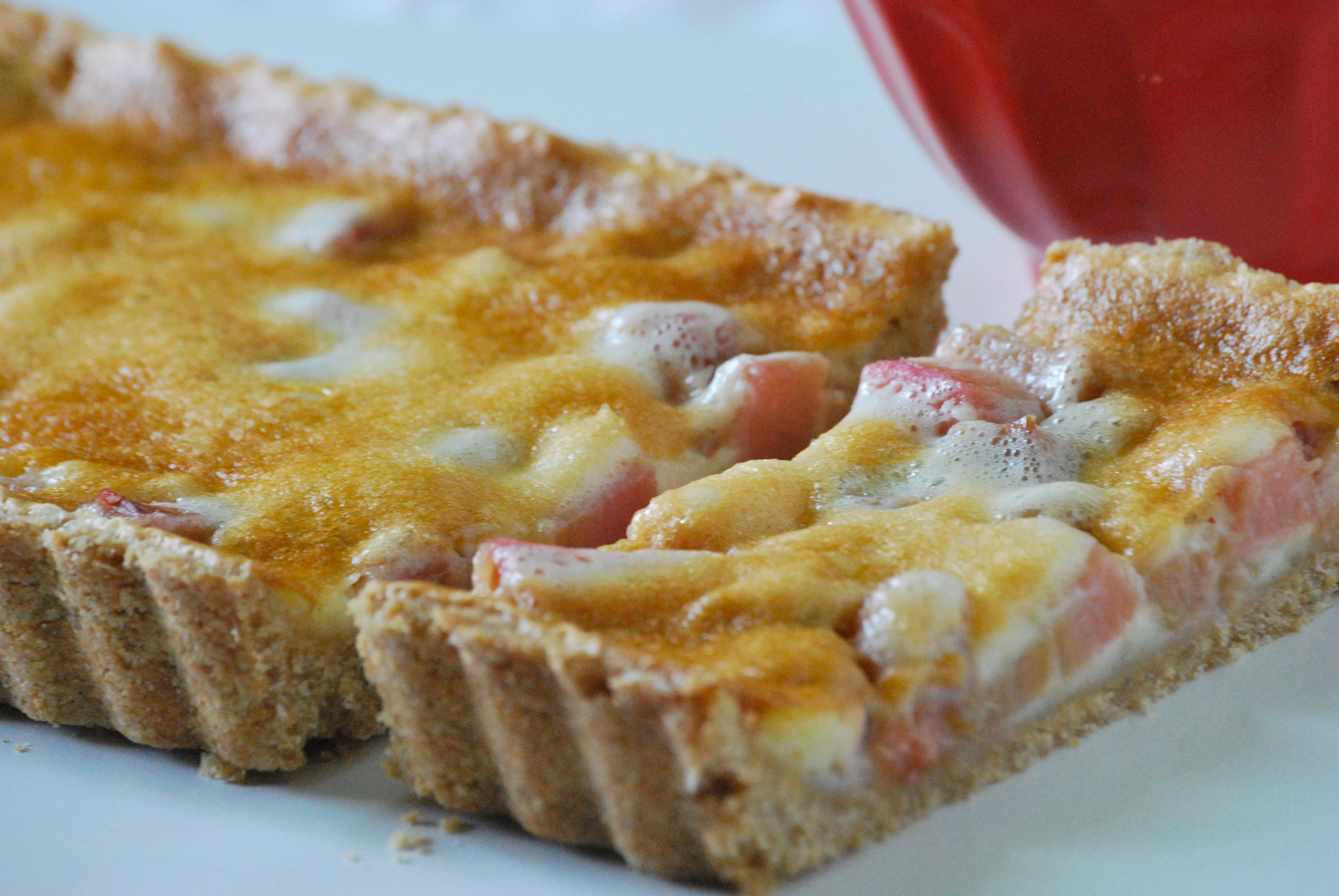
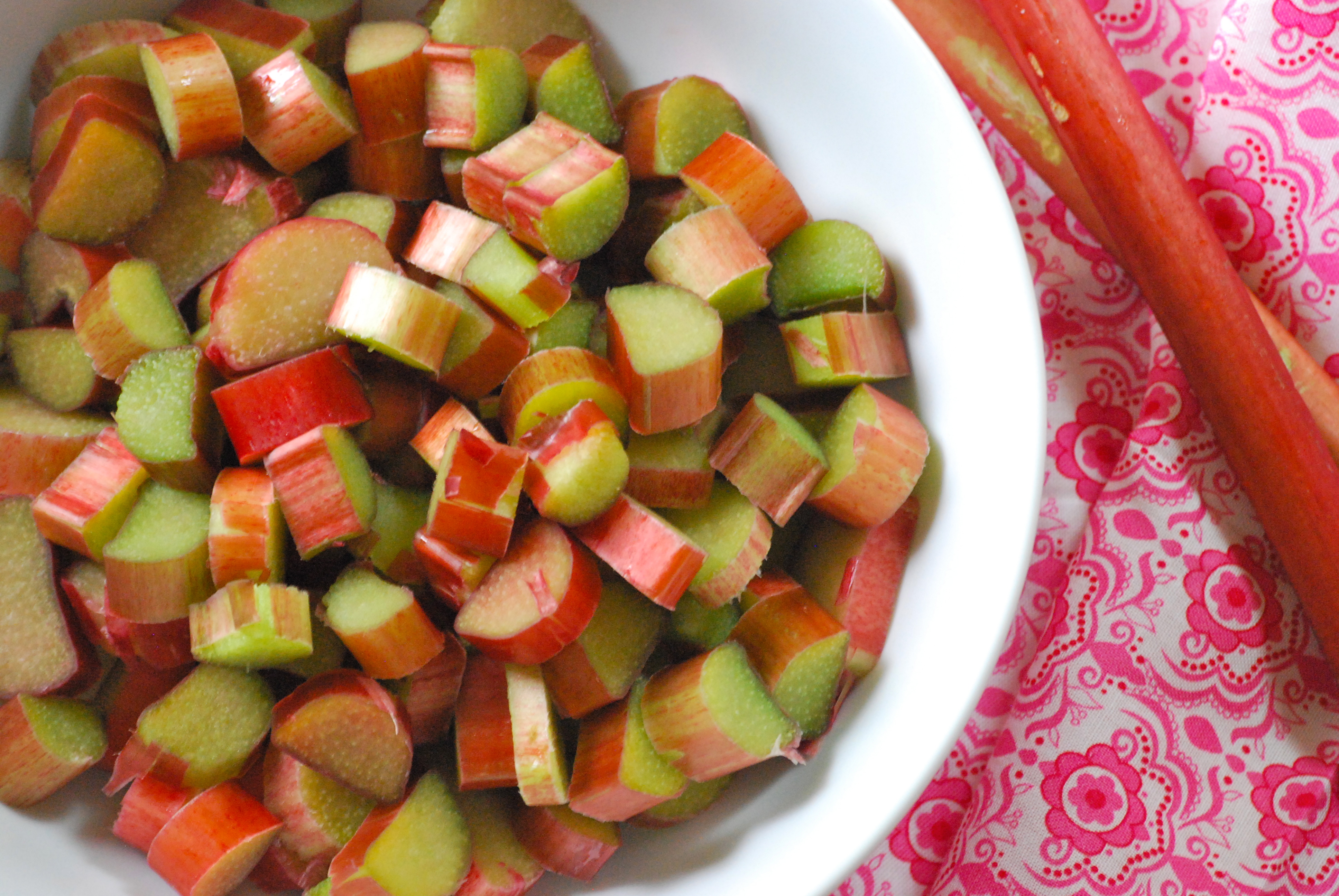
Yes, I know I wrote about rhubarb last week in this coffee cake recipe, but if you’re ready for another go, this week I’m offering up a phenomenal tart with rhubarb and cardamom.  I ate almost the entire thing the day I made it.  It’s that good.  I spotted this tart years ago on Helene’s beautiful blog, Tartlette.  Rhubarb with cardamom is one of those brilliant combinations that you really must try.  The cardamom is very subtle– a little goes a long way– but it really seems to enhance the tart flavors of the rhubarb.

I wanted to make a relatively fuss-free crust for this tart– one that doesn’t have to be rolled out, but rather just gently patted into a pan.  This one turned out perfectly.  I blind baked the crust to ensure that it was nice and firm, since there’s nothing worse than having a fabulous filling ruined by a soggy crust.  As for that filling, this one is a divine creamy custard.  It’s just a few simple ingredients, but the creme fraiche makes it spectacular.  (Honestly, I think creme fraiche makes everything spectactular).  Like a little kid, I couldn’t stop licking the spatula!  With this recipe, you will probably have leftover custard, so pour it into baking cups and bake it along-side the tart.  They’ll be little bonus desserts.  Enjoy!

The Recipe: Rhubarb and Cardamom Tart

(Makes one 9-or-10-inch round tart or a 14-x-5-inch rectangle tart)

For poaching the Rhubarb:

5 stalks rhubarb, chopped (1 1/2 cups)

squeeze of lemon juice

1/2 cup water

1 tablespoon honey

For the Custard Filling:

3 eggs, room temperature

1 cup granulated sugar

1 cup creme fraiche (full-fat sour cream would work, too)

1/4 teaspoon cardamom

sprinkle of salt

For the Crust:

1 1/4 cups white whole wheat flour

3 tablespoons granulated sugar

1/2 teaspoon cardamom

sprinkle of salt

4 tablespoons cold butter, cut into 6-8 pieces

1 egg, beaten

To poach the rhubarb: In a small saucepan, bring the 1/2 cup of water, honey, and squeeze of lemon to a boil.  Place the chopped rhubarb in the water and cook for 2 minutes.  Remove rhubarb from water and set aside.  This can be done a day in advance — just place in a covered bowl in the refrigerator.  The water from the rhubarb is full of flavor — save it if you like and be creative with it!  Cook it down to form a syrup or mix it with a cocktail.

Meanwhile, prepare the tart crust.  Preheat an oven to 350°F.  In a large glass bowl, add the flour, sugar, cardamom, and salt.  Whisk them together to combine.  Using a pastry blender or fork, cut in the  butter, until the mixture resembles breadcrumbs.  Do not let the mixture become pasty.  Stir the beaten egg into the flour mixture.  The dough should look dry and crumbly.

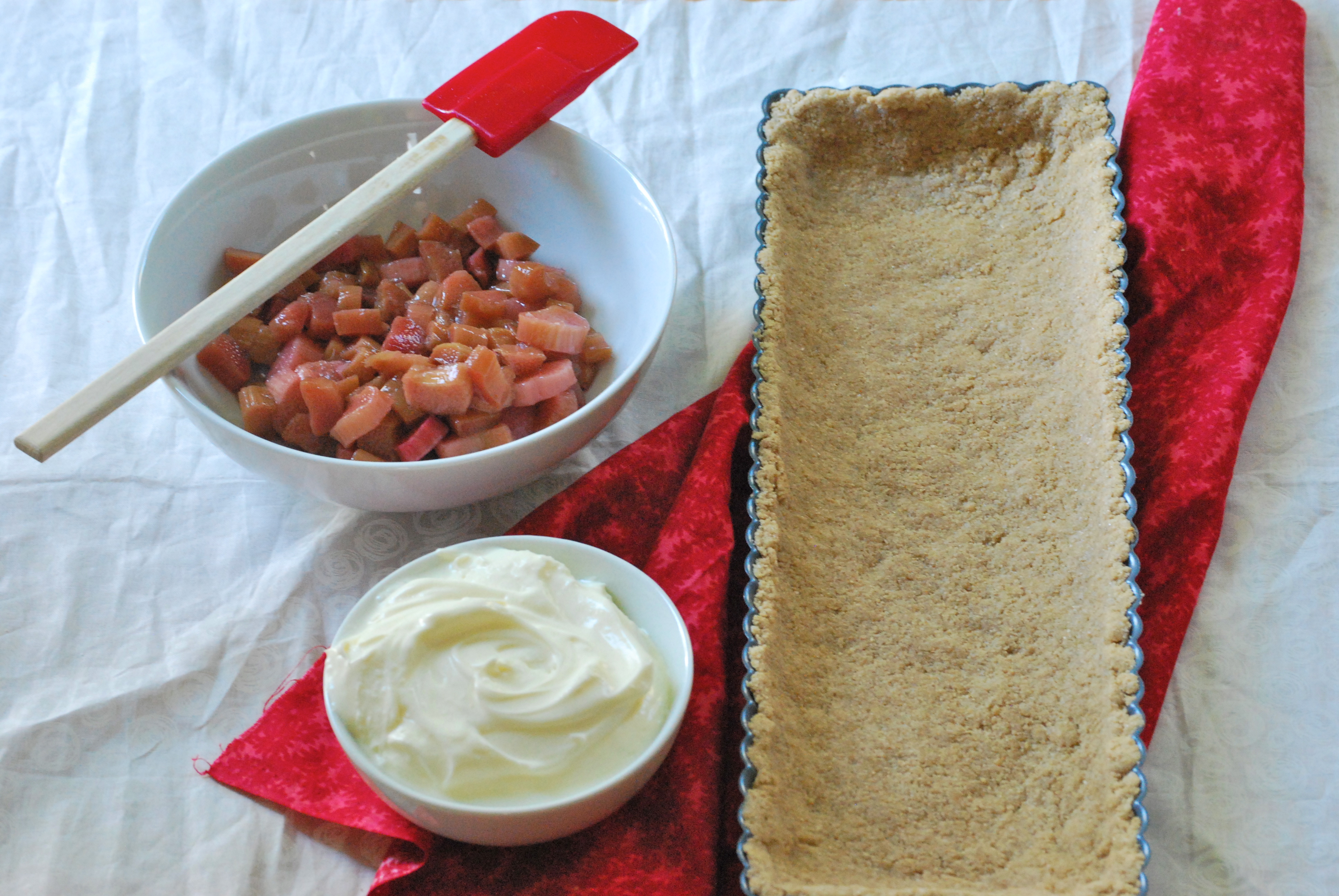
Press the dough evenly and gently into a buttered tart pan, using floured fingertips.  Place a piece of lightly butter parchment paper over the tart and fill with baking weights or dried beans (I use the same beans over and over).  Blind bake for about 12-15 minutes, or until the tart is golden brown.  Remove from oven and let cool.

To make the custard filling:  In a bowl of a stand mixer fitted with a paddle attachment, add the eggs, sugar, cardamom, and sprinkle of salt.  Mix for  a couple of minutes until it is pale and airy.  Add the creme fraiche and mix until well combined.

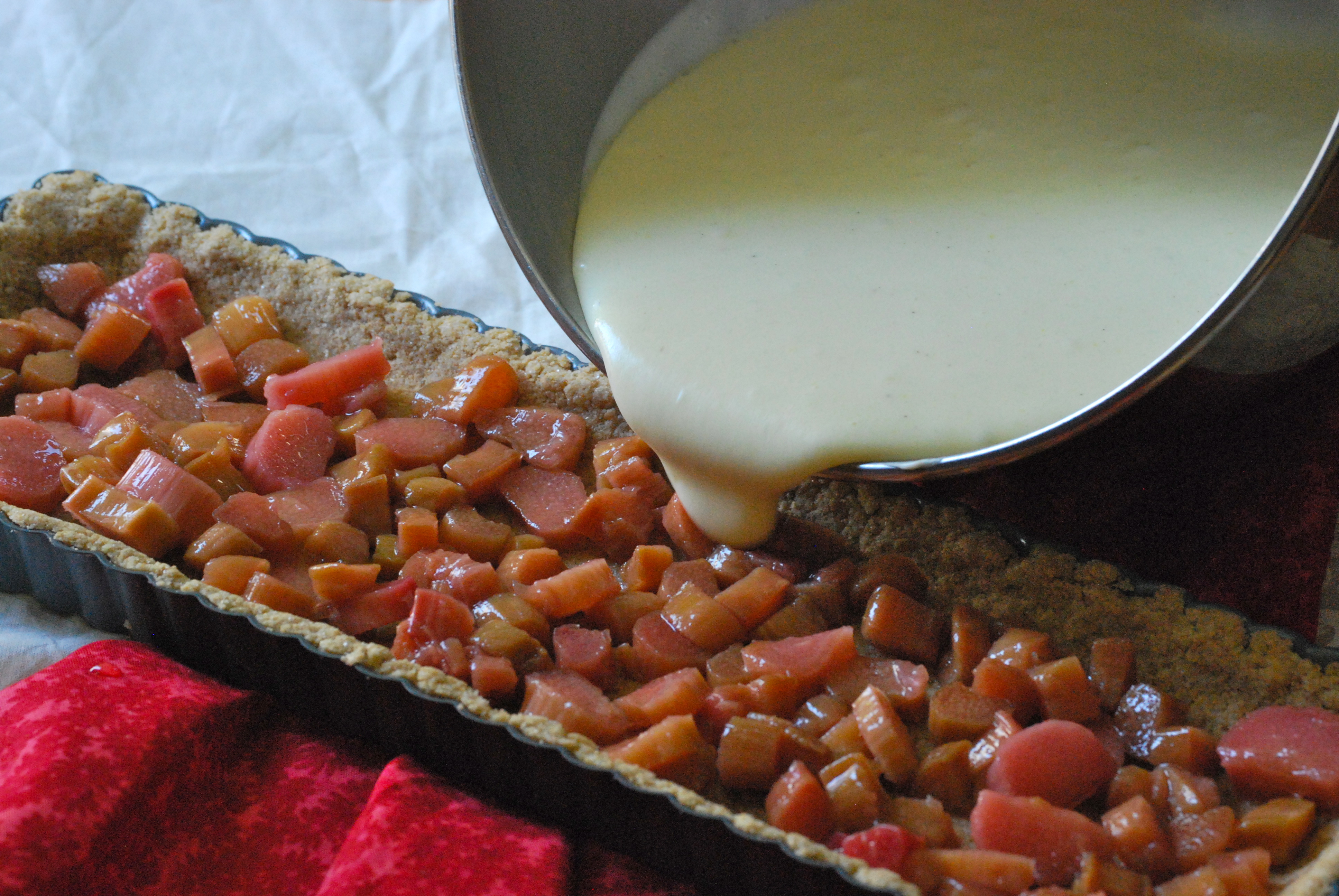
To assemble the tart:  Distribute the poached rhubarb into the prepared tart crust.  Pour the custard filling over the rhubarb — being careful to not overfill it.  You will have leftover custard filling.  If you like, butter about 4 small ramekins and fill them with the custard.  Bake along side the tart for a bonus treat.  Place the tart on a baking sheet and bake for about 25-30 minutes, or until it is a beautiful golden brown.  Remove from the oven and let cool completely.  Serve with whipped cream, if desired.  Enjoy!

Source:  Custard filling adapted from Tartlette.  Crust adapted from How to Bake

Thanks for stopping in today!
Laurie
One of the best perks of late spring and early summer cooking is that so many dishes are quick and simple– there’s isn’t much fussing or preparation time.  This is a good thing– especially if you have little ones either underfoot or begging to get outside and enjoy the sunshine.  And even if you don’t have to keep one eye on the kids while you cook, who wants to spend these longer, warm days in the kitchen?  I know I sound like a skipping record, but I happen to be delighted that summer produce is starting to appear.  Aside from the fresh seasonal flavors, it’s easy– and that means more playtime.

This week, it’s time for asaparagus!  Yes, that sentence was worthy of an exclamation point.  You see, asaparagus isn’t around for long, so when it arrives, I go all out.  I have several simple asparagus dishes that I make this time of year.  This gorgeous tart is one of my favorites. And this one, which combines two fantastic seasonal ingredients– asparagus and morels, still makes me swoon. But the best of all is the dish in today’s post- roasted asparagus with balsamic browned butter.  It is, unquestionably, my favorite way to prepare asparagus.

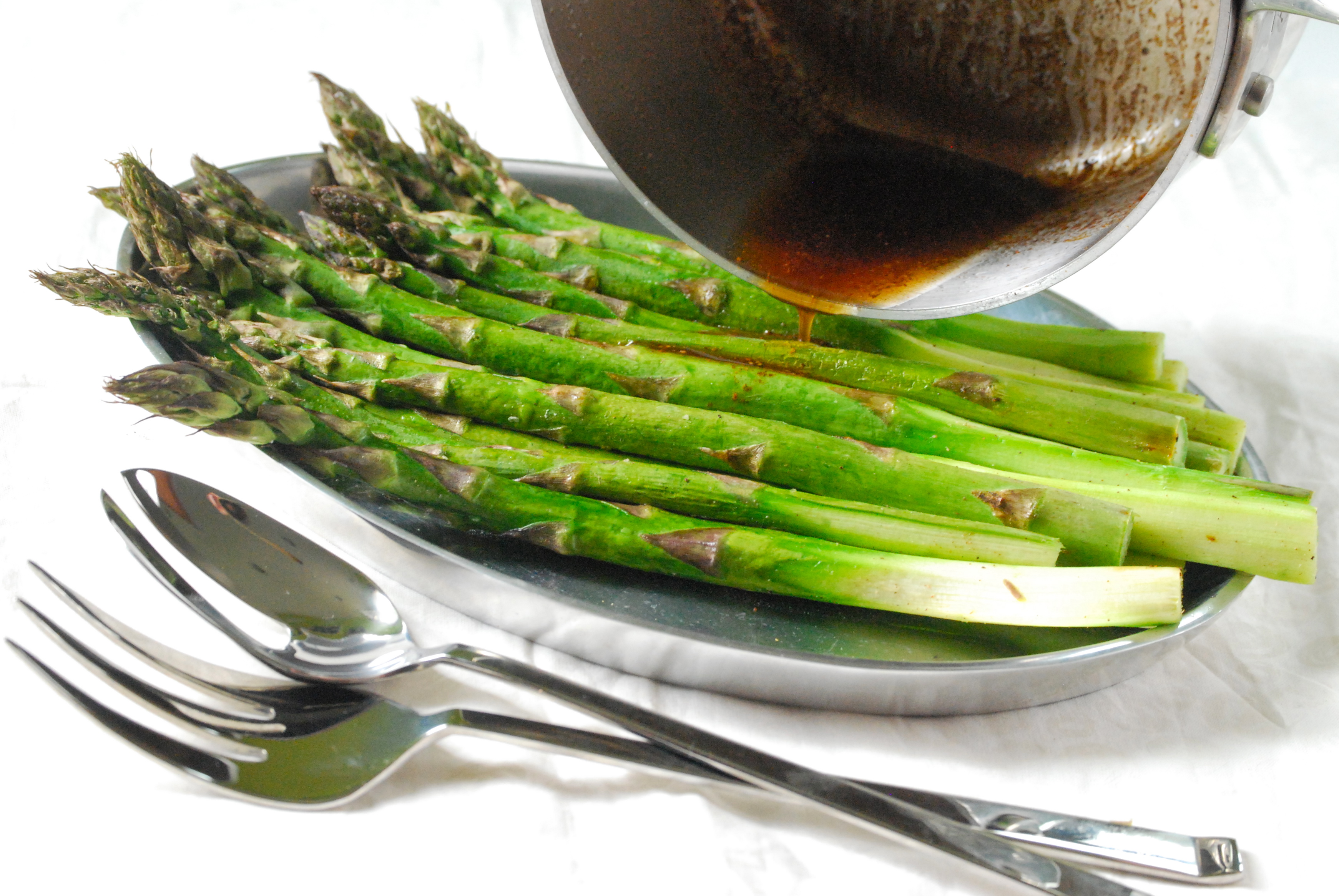
I first made this dish years ago for my in-laws.  They loved it enough that they started preparing asparagus this way, too.  I think the chances are better than average that you’ll do the same.  This side is perfect because it relies on a simple flavor combination.  Browned Butter, balsamic vinegar, and soy sauce.  That’s it.  These three ingredients pack an amazing punch.  So much so, that you don’t want your asparagus swimming in the sauce.  Less is more, here.

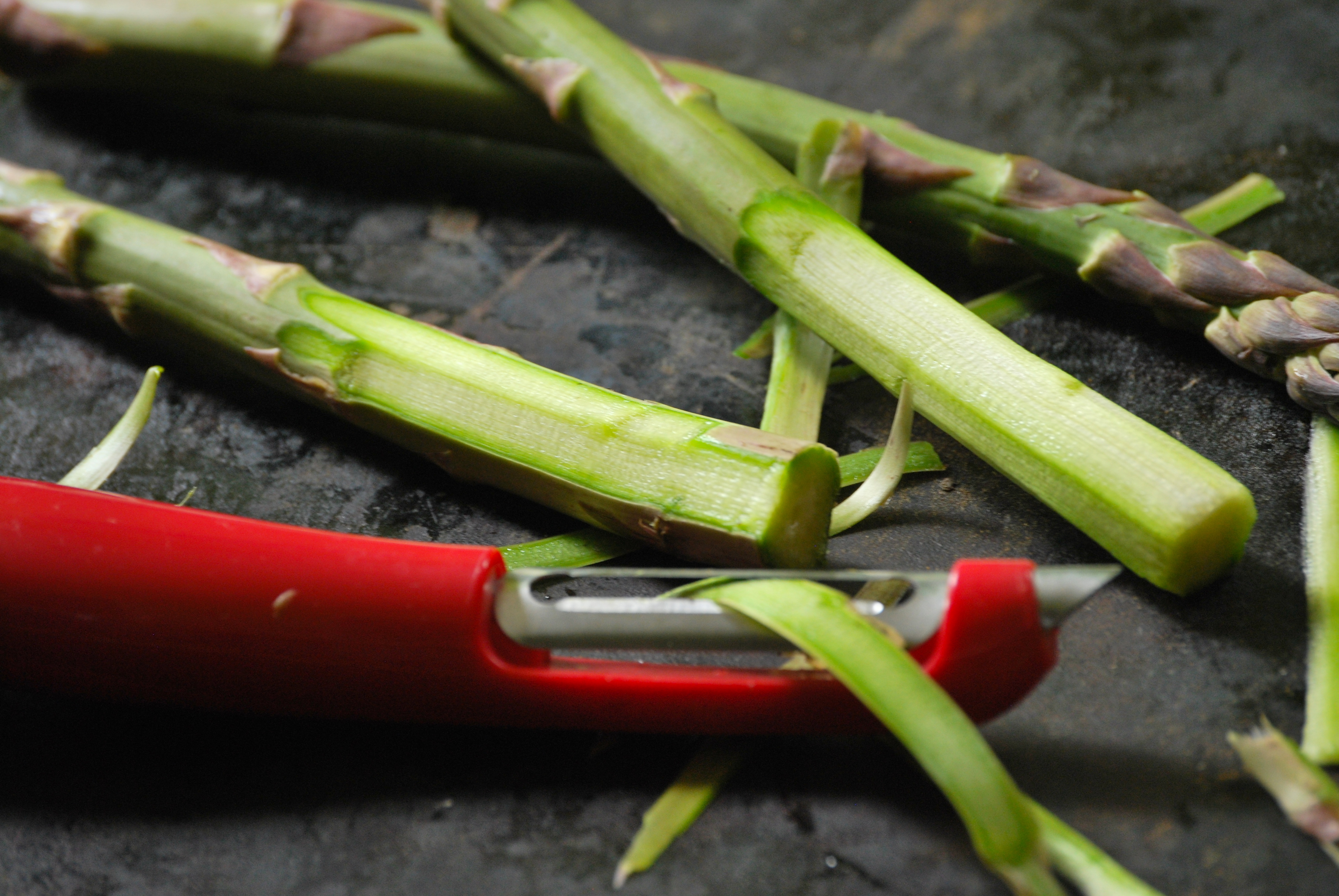
A word or two about the preparation of the asparagus.  First, use fresh seasonal asparagus.  Don’t get me started on that asparagus you often see year-round in some grocery stores and restaurants.  Those oversized, tough, tasteless, shoots are not what I’m talking about.  Asparagus should be enjoyed when it was meant to be– for those few weeks in spring when it’s fresh and tastes amazing.  When looking for asparagus at the market, look for the tops of them to be tight and closed.  This indicates they were recently harvested.  Asparagus should be eaten as soon as possible after you buy it, as the flavor dissipates pretty quickly.  Also, I don’t follow the school of thought that you should snap huge chunks off the bottom of the stem to avoid the “woody” portion.  Instead, I simply use a vegetable peeler and peel the bottoms.  It becomes just as tender as the top section and you avoid wasting a fair amount.  Hope you enjoy this dish!

The Recipe:  Roasted Asparagus with Balsamic Browned Butter

1 pound asparagus

olive oil, to drizzle

kosher salt

cracked black pepper

2 tablespoons unsalted butter

2 teaspoons soy sauce

1 teaspoon balsamic vinegar

toasted, sliced almonds, optional

shaved lemon zest, optional

Preheat an oven to 400°F.  Line a baking sheet with parchment paper; set aside.

Wash and dry the asparagus.  Cut off the very bottoms with a sharp knife.  Use a vegetable peeler to peel the bottom 1-inch to 1  1/2 -inch.  Toss the asparagus with a drizzle of olive oil and a sprinkle of salt and pepper.  Place on the baking sheet and roast for about 12 minutes, or until tender.

Meanwhile, place the butter in a small sauce pan over medium heat.  Stirring frequently, melt the butter until it is a deep golden brown, about 3 minutes.  Be careful not to burn it.  Remove from heat and add the soy sauce and vinegar to the pan.  Mix it together well with a wooden spoon, making sure to incorporate any brown bits in the butter.

Place the asparagus on a serving platter and pour the balsamic browned butter over the top.  Sprinkle with toasted almonds and a bit of shaved lemon zest.  Serve immediately.  Enjoy!

Source:  Adapted from Cooking Light

Thanks for stopping in — have a wonderful weekend!

Laurie
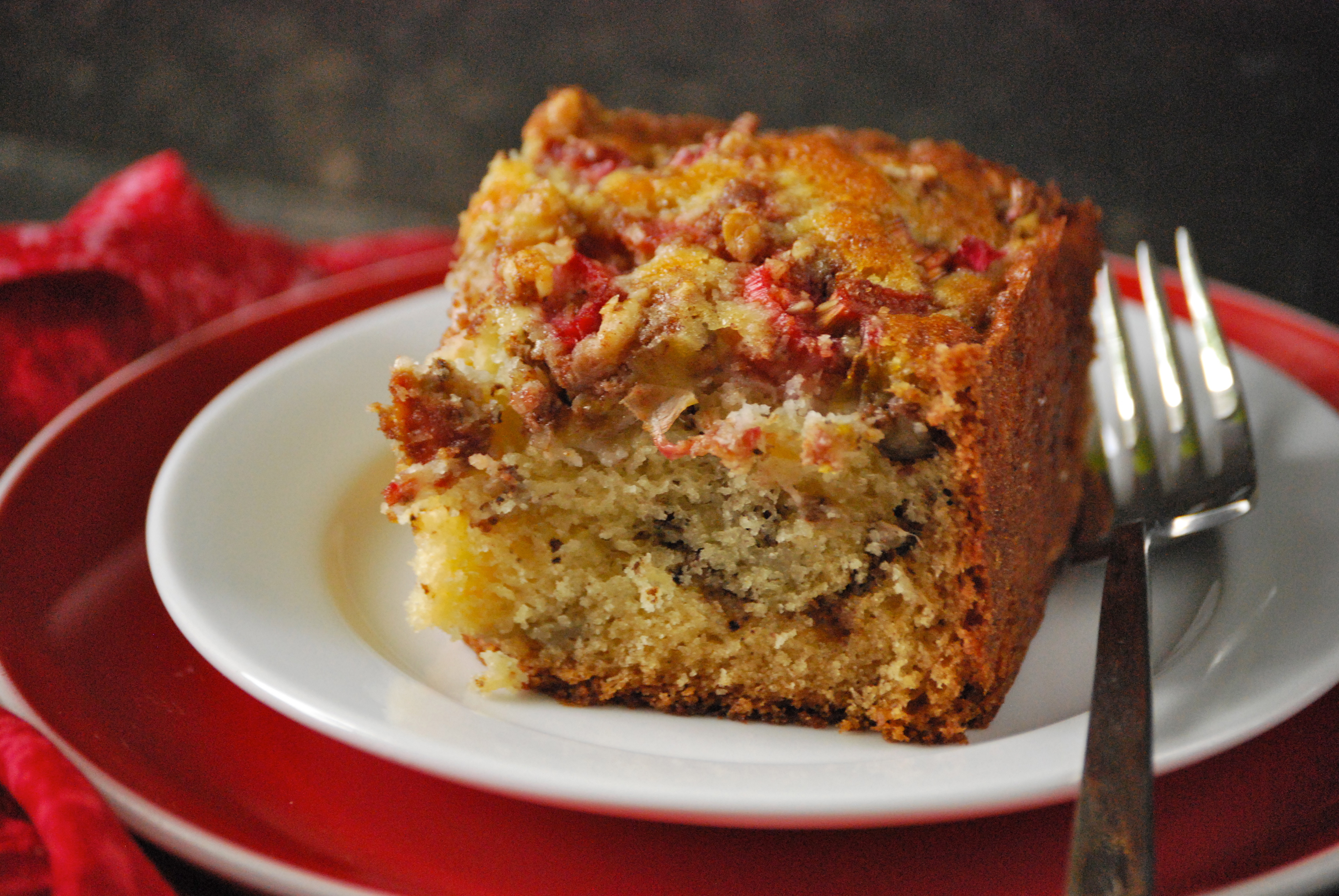
And another seasonal food makes it’s first appearance!  This time it’s rhubarb’s turn in the spotlight.  You’ll probably see a similar line here next week with another ingredient–maybe even every week throughout Spring and Summer as I blog.  I can’t help it!  I just get so excited for all of this seasonal gorgeous, vibrant produce.

Rhubarb has been cropping up everwhere around here in the last week.  The first Twin Cities farmers’ markets of the season opened this weekend, so I hauled the family to our favorite one in St. Paul.  It was fun getting a chance to chat with the vendors again after the Winter break.  I’ve found that the first few weeks are a good time to connect with them– to see what they’ll be offering and how the season is shaping up– since they aren’t quite as busy as they’ll be by Summer.  I bought many things, including a bunch of rhubarb.  Even better, a friend was also kind enough to give me a huge bundle.  Perfect.

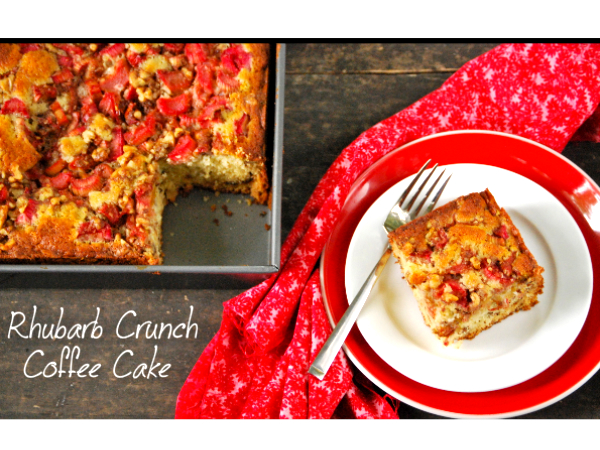
So what to do with all this rhubarb?  Well, this cake and this crumble are two of my favorite things to make with it.  But I’ve also found the coffee cake that you see in this post.  I love coffee cakes.  They’re perfect for…well…coffee in the afternoon, of course.  They’re also easy to make and stay moist for days.

The rhubarb is obviously the main attraction here.  It adds a notable, though restrained tartness.  The cake is perfectly sweetened.  I used my homemade 1 % yogurt, which was a nice substitute for sour cream.  It kept the cake wonderfully moist, and as a bonus, it has less calories.  The next time I make this one, I’m going to try it with white whole wheat flour to get the benefits of using a whole grain.  I’ll let you know how it turns out.  And if you try it that way first, let me know about it.  Enjoy!

The Recipe:  Rhubarb Crunch Coffee Cake

1/2 cup (1 stick) unsalted butter

1 cup granulated sugar

2 eggs at room temperature

1 teaspoon vanilla

1 cup yogurt or sour cream

2 cups all-purpose flour

1 1 /2 teaspoon baking powder

1 teaspoon baking soda

1/2 teaspoon kosher salt

For the Rhubarb and Crunch Topping:

2 cups chopped rhubarb

1 /4 cup plus 2 tablespoons brown sugar

1 tablespoon all-purpose flour

1 teaspoon cinnamon

1/2 cup chopped walnuts

1 tablespoon butter, softened

pinch of kosher salt

Preheat the oven to 350°F.   Butter an 8-inch square cake pan.

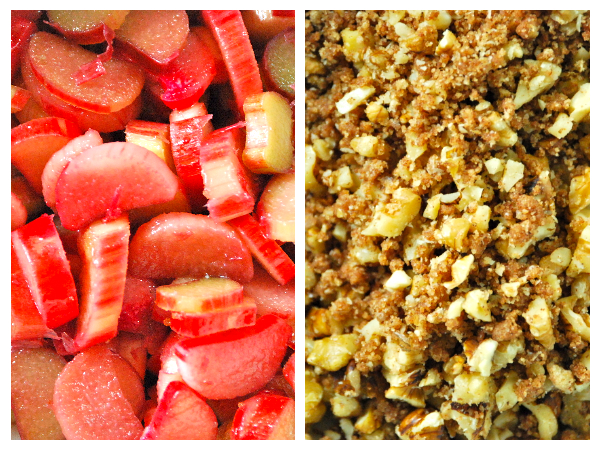
To prepare the Rhubarb and the Crunch Topping: Combine 2 cups of rhubarb with 2 tablespoons of brown sugar in a small bowl; set aside.  Using a fork, combine 1/4 cup of brown sugar, 1 tablespoon of flour, cinnamon, 1 tablespoon of butter, and a pinch of kosher salt in a small bowl until crumbly.  Stir in the walnuts; set aside.

In a medium-sized bowl, sift or whisk together 2 cups of all-purpose flour, baking soda, baking powder, and kosher salt; set aside.

In a bowl of a stand mixer fitter with a paddle attachment, cream together 1 stick of butter and granulated sugar until creamy.  Add the eggs, one at a time, scraping down the sides of the bowl after each one.  Cream for 2-3 minutes, until light and fluffy.  Add the yogurt and vanilla and mix until combined.  The mixture may look curdled at this point.  That is ok.  Add the dry ingredients and mix until everything is just combined, being careful not to over mix.

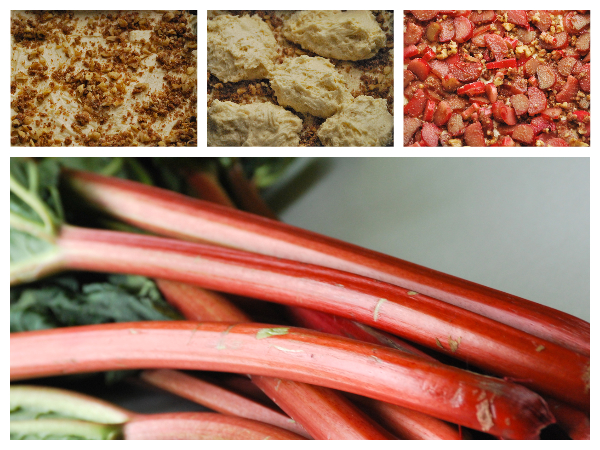
Place half of the cake batter into the pan and smooth out.  Sprinkle half of the crunch topping over the batter in the pan.  Dollop the remaining cake batter on top of the crunch topping and smooth out with an offset spatula.  Combine the remaining crunch topping with the rhubarb and pour that mixture evenly on the top of the cake.  Place in the oven and bake for about 55-60 minutes.  Check the center for doneness with a toothpick.  This cake will taste great right away and will be even more moist the following day.  Store covered at room temperature.  Enjoy!

Source:  Adapted from Kitchen Simplicity

Thanks for stopping by Relishing It!

Laurie